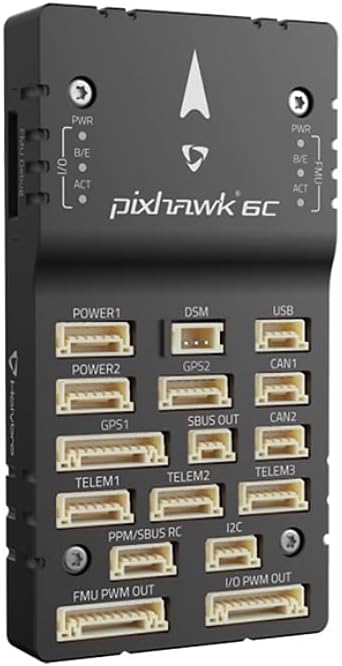
Pixhawk 6C Flight Controller
5.0Editor score
High-performance H7 processor
Dual redundant IMUs
Integrated vibration isolation
This guide compares the top flight controllers for hybrid VTOL and VTOL drones, analyzing performance, firmware support, and hardware specs for reliable
Choosing the right flight controller for hybrid VTOL and VTOL drones is critical for stable transitions between vertical and forward flight modes. These systems require precise sensor fusion and robust processing to handle the dynamic shifts in aerodynamics during takeoff and landing.
We evaluated ten leading flight controllers based on their processor speed, sensor redundancy, firmware compatibility, and physical build quality. Each product was selected for its ability to support complex mixed-mode flight profiles found in modern autonomous and hobbyist drone applications.
Each review highlights key specifications, pros, cons, and ideal use cases to help you match hardware to your specific build requirements. Prices and availability change frequently, so verify current details on the product pages before finalizing your purchase decision.
5.0Editor score

4.8Editor score
4.4Editor score
This side-by-side comparison examines hardware specifications, firmware options, and physical dimensions across all ten selected flight controllers to help you identify the most suitable option for your hybrid VTOL or VTOL drone build.


The Pixhawk 2.4.8 PX4 Open Source Flight Controller stands out as a powerful master controller capable of supporting fixed-wing, multi-rotor, helicopter, and hybrid VTOL configurations. With a rating of 4.8, it offers robust autonomy features driven by its advanced 32-bit fail-safe co-processor and high-performance ARM Cortex M4 core.
We may earn a commission when you buy through this link, at no additional cost to you.
Its standout quality lies in its open-source nature, which enables hobbyists and developers to perform secondary development and customize rich function modules for specialized mission profiles. This flexibility ensures that the hardware can evolve alongside your software needs for complex autonomous or remote driving applications.
While it requires careful assembly and calibration, the included quick start guide helps new players with basic DIY setups. The trade-off of a larger board size is acceptable given the comprehensive sensor integration and the ability to support a wide range of vehicle types beyond just drones.
This flight controller is ideal for researchers, students, and developers who need a reliable, high-end autopilot starter that can handle secondary development projects. It is the first choice for those seeking extensive customization and proven stability in autonomous vehicle applications.
The open-source architecture allows capable hobbyists to carry out secondary development, adapting the controller for unique hardware configurations and specialized flight logic.
Integrated MPU 6000 3-axis accelerometer and fail-safe co-processor ensure accurate flight dynamics calculation and reliable operation even during motor or sensor failures.
We may earn a commission when you buy through this link, at no additional cost to you.
The Pixhawk 6C Flight Controller delivers massive computing power with its 32-bit STM32H743 ARM Cortex-M7 core running at up to 480MHz, making it suitable for complex autonomous vehicle algorithms and academic research. Its pre-installed PX4 Autopilot ensures immediate usability for developers focused on advanced flight control systems.
We may earn a commission when you buy through this link, at no additional cost to you.
Key strengths include dual redundant IMUs from Bosch and InvenSense, combined with onboard heating resistors for temperature control, ensuring sensors work at optimum temperatures for unmatched reliability. The newly engineered integrated vibration isolation system effectively filters out high-frequency vibrations and reduces sensor noise to guarantee precise readings.
The main trade-off is the hardware-switchable PWM signal mode between 3.3V and 5V, which requires opening the casing to access. This adds a slight maintenance step but ensures compatibility with a wide range of peripheral hardware for diverse UAV applications.
This controller is perfect for professors, students, and corporate labs conducting academic research or developing commercial autonomous vehicle applications. It offers a cost-effective, ultra-low profile design that balances high performance with portability and durability in field conditions.
Designed based on the Pixhawk FMUv6C open standard, the integrated vibration isolation system filters high-frequency drone vibrations to guarantee precise sensor readings and better overall flight performance.
Integrated onboard heating resistors provide temperature control for dual redundant IMUs, ensuring they consistently work at optimum temperature for unmatched reliability in varying environments.
We may earn a commission when you buy through this link, at no additional cost to you.
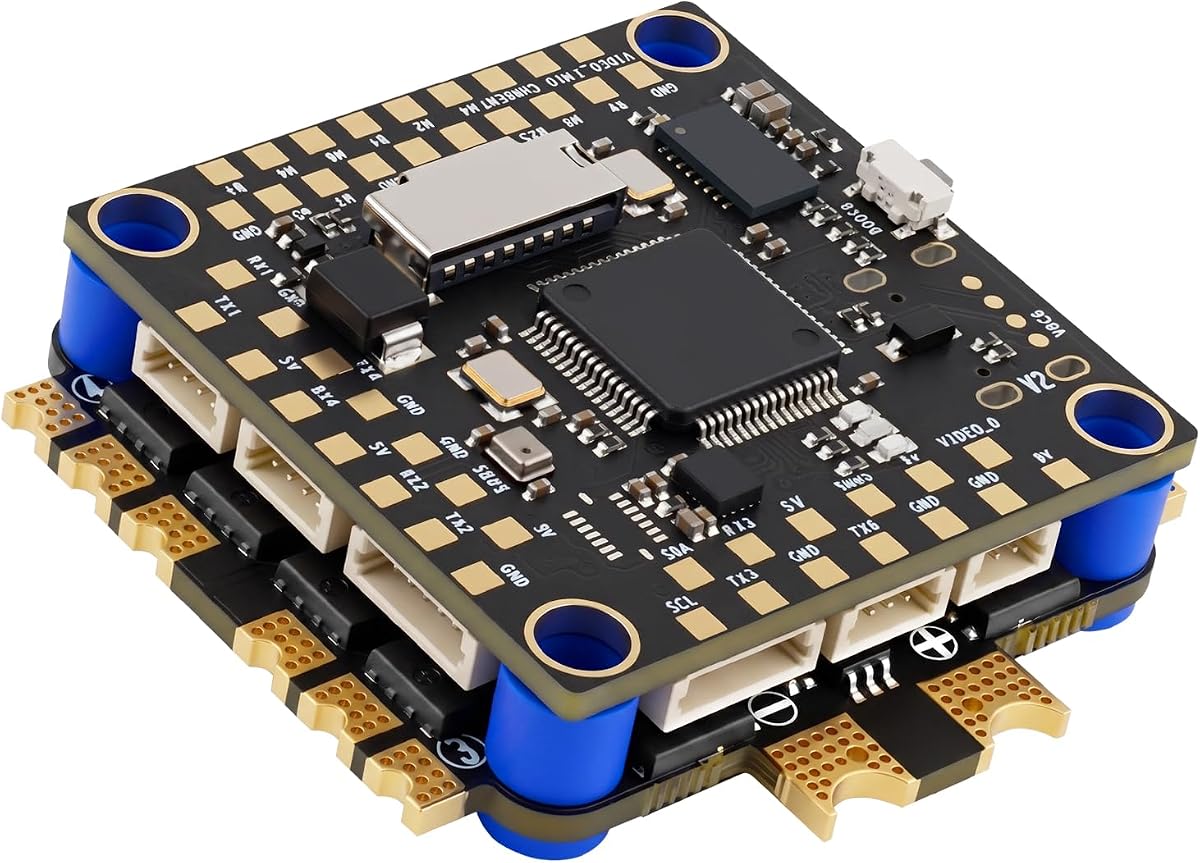
The AERO SELFIE F405NC Flight Controller offers a reliable and affordable combination for lightweight builds, featuring an STM32f405 processor and dual IMUs for superior motor control. Rated 4.4, it supports versatile firmware options including Betaflight, INAV, and ArduPilot for enhanced flight performance and stability.
We may earn a commission when you buy through this link, at no additional cost to you.
Its standout qualities include a 4-in-1 60A ESC 8bit that provides continuous 60A per channel and burst current over 80A, ensuring optimal power and responsiveness. The compact design with a 30.5×30.5mm mounting pattern makes it easy to integrate into various drone frames without adding significant weight.
While it is limited to 2S-6S LiPo batteries and lacks the raw speed of newer H7 processors, this is acceptable for many FPV and racing builds where cost and weight are primary concerns. The 6 UART ports and OSD support offer sufficient expansion for telemetry and GPS sensors.
This stack is ideal for beginners and professionals seeking a budget-friendly solution that still offers dual IMU redundancy and compatibility with complex autonomous firmware. It is a strong choice for those who need a reliable, compact flight controller for racing or FPV hybrid VTOL builds.
Compatible with Betaflight, INAV, and ArduPilot, this stack offers quick configuration options, ensuring ease of setup for both beginners and professionals building hybrid or racing drones.
With a total weight of 23.2g for both ESC and controller, the stack fits a wide variety of frames while ensuring easy installation and efficient space management for lightweight builds.
We may earn a commission when you buy through this link, at no additional cost to you.
The AERO SELFIE H743 Flight Controller features a powerful STM32H743 processor running at 480MHz with dual IMUs, offering superior motor control for lightweight builds. With a 32-bit ESC supporting 2S-6S LiPo batteries, it ensures optimal power and responsiveness while maintaining compatibility with Betaflight, INAV, PX4, and ArduPilot.
We may earn a commission when you buy through this link, at no additional cost to you.
Key strengths include 7 UART ports, 10 PWM outputs, and OSD support, providing vast expansion potential for additional sensors, telemetry, or peripherals. The compact 30.5×30.5mm mounting pattern ensures compatibility with a wide variety of drone frames for efficient space management.
Although it has a lower rating of 3.7 compared to other models, it offers high performance at a competitive price. The trade-off of lower ratings may stem from integration complexity, but its powerful processor and robust connectivity make it a viable option for advanced users.
This flight controller is best suited for users who need a high-performance H7 processor in a compact stack without breaking the budget. It is ideal for FPV and racing drones that require precise throttle response and extensive sensor integration capabilities.
The STM32H743 processor running at 480MHz delivers massive computing power for complex flight algorithms and responsive control in racing or autonomous hybrid VTOL configurations.
With 7 UART ports, 10 PWM outputs, and CAN bus support, the H743 controller offers vast expansion potential for telemetry, GPS, and other advanced peripherals.
We may earn a commission when you buy through this link, at no additional cost to you.
The PIX 2-12S Mavlink SBUS PPM CRSF Flight Controller is specifically designed as a core board for VTOL multirotor and fixed-wing aircraft. Featuring an STM32F405VGT6 main controller with integrated MPU6500 gyroscope, VCM5883L magnetometer, and LPS22HB barometer, it ensures precise flight control across diverse mission profiles.
We may earn a commission when you buy through this link, at no additional cost to you.
Its standout quality is the support for 2 to 12S power supply, making it suitable for larger and more powerful drone configurations. The 6-channel PWM output supports Oneshot/DSHOT protocols, enabling rapid throttle response essential for stable transitions in hybrid VTOL builds.
The product excludes ESC hardware, which means users must source their own motor controllers. However, the inclusion of basic wiring and connectors simplifies the initial setup process for developers building custom autonomous driving systems.
This controller is perfect for advanced builders seeking a specialized solution for VTOL multirotor or fixed-wing autonomous missions. It offers the necessary sensor fusion and power handling for complex flight profiles that require robust stability and precise control over long durations.
Supports 2 to 12S power supply, allowing integration into larger VTOL multirotor builds that require higher voltage for extended flight times and increased payload capacity.
The STM32F405VGT6 controller integrates MPU6500 gyroscope, VCM5883L magnetometer, and LPS22HB barometer for reliable and precise flight dynamics calculation across all flight modes.
We may earn a commission when you buy through this link, at no additional cost to you.
The H743 Flight Controller with 60A 32 bit ESC offers a powerful combination featuring a CORVON H743 processor with dual IMUs and a 60A ESC. Rated 5.0, this stack provides a reliable combination for lightweight builds, supporting 2S-8S LiPo batteries for versatile power configurations.
We may earn a commission when you buy through this link, at no additional cost to you.
Its standout qualities include comprehensive connectivity with 7 UART ports, 10 PWM outputs, and CAN, I2C, and OSD support. This makes it highly expandable for telemetry, GPS, and additional sensor integration required for complex autonomous or racing drone applications.
The stack is lightweight at 23.2g and fits standard 30.5×30.5mm mounting patterns, ensuring easy integration into various frames. While the high power support is a strength, it requires careful ESC calibration to optimize performance and avoid unnecessary power draw during idle flight.
This stack is ideal for professionals and hobbyists who need high-performance hardware with extensive expansion capabilities. It supports versatile firmware like Betaflight, PX4, INAV, and ArduPilot, making it a strong choice for FPV, racing, and hybrid VTOL builds.
Supports 2S-8S LiPo batteries and is compatible with Betaflight, INAV, PX4, and ArduPilot, ensuring flexibility for various drone types and mission profiles.
Dual IMUs from BMI088 and BMI270 provide robust motion sensing for accurate flight stabilization and navigation in dynamic and challenging environments.
We may earn a commission when you buy through this link, at no additional cost to you.
The H743 Flight Controller with 50A 8 bit ESC features a STM32H743 processor running at 480MHz with 2MB Flash memory, delivering ultra-responsive motor control for racing and FPV drones. Rated 5.0, it supports 2S-6S lithium batteries and offers high-frequency PWM with DSHOT and ONESHOT protocols for precise throttle response.
We may earn a commission when you buy through this link, at no additional cost to you.
Key strengths include versatile firmware compatibility with Betaflight, ArduPilot, PX4, and INAV, enhancing flight performance and stability across various drone types. The compact design ensures easy integration into a wide range of frames without adding significant weight to the overall build.
While it is limited to 6S battery support, this is sufficient for most racing and hybrid VTOL applications where weight is a critical factor. The trade-off is minimal compared to the benefits of responsive control and extensive connectivity options for advanced users.
This stack is perfect for builders who need a lightweight, high-performance flight controller that can handle complex firmware configurations. It is ideal for racing drones and VTOL models requiring precise throttle response and robust sensor integration.
Supports high-frequency PWM, DSHOT, and ONESHOT protocols alongside compatibility with Betaflight, INAV, and ArduPilot for enhanced performance across diverse drone applications.
With a total weight of 21.5g and standard 30.5×30.5mm pattern, this stack simplifies installation and enhances assembly efficiency for lightweight frames.
We may earn a commission when you buy through this link, at no additional cost to you.
The F405 Wing Flight Controller is designed specifically for fixed-wing drones with VTOL capabilities, offering versatile flight modes controlled via the ArduPilot APP. Rated 5.0, its F405 processor ensures fast and stable processing for smooth flight experiences in both horizontal and vertical flight conditions.
We may earn a commission when you buy through this link, at no additional cost to you.
Its standout qualities include the ability to easily configure and monitor flight parameters via smartphone APP control, making it user-friendly for beginners and experienced pilots alike. The lightweight and compact design minimizes added weight while maintaining robust functionality for various fixed-wing models.
The trade-off is that it is optimized for fixed-wing builds, limiting its use in pure multirotor configurations. However, this specialization ensures superior performance for hybrid VTOL builds that require efficient gliding and transitioning capabilities.
This flight controller is ideal for pilots building fixed-wing VTOL models that need simple setup and extensive features. It offers flexibility for different builds and is compatible with various fixed-wing drone models, making it a strong choice for specialized mission profiles.
Users can easily configure and monitor flight parameters via smartphone, simplifying the setup process for beginners and experienced pilots building fixed-wing VTOL models.
Designed for fixed-wing drones with VTOL capabilities, it ensures versatile flight modes and fast, stable processing for smooth transitions and long endurance flights.
We may earn a commission when you buy through this link, at no additional cost to you.
The COREWING F405 V2 Flight Controller is built to fit RC airplane and drone applications, providing a compact F405 architecture that ensures high-speed processing and reliable flight performance. Rated 5.0, it is designed for hobbyists who need a stable flight controller for complex multi-mode aircraft.
We may earn a commission when you buy through this link, at no additional cost to you.
Its standout quality is its compact size and standard mounting pattern, which makes it easy to integrate into various airframes without significant modifications. The high-speed processing ensures that the controller can handle the rapid response requirements of aerobatic maneuvers and VTOL transitions.
While it may require technical expertise for setup and lacks extensive documentation compared to open-source giants, the hardware quality is robust. The trade-off is acceptable for experienced builders who prioritize compactness and performance over extensive community support.
This controller is ideal for advanced hobbyists building RC airplanes or VTOL drones that require a lightweight yet powerful flight controller. It is a strong choice for those seeking reliable flight performance in compact and specialized airframes.
Designed specifically for RC airplane and drone applications, its compact size and standard mounting pattern ensure easy installation without significant modifications to the airframe.
The F405 architecture delivers high-speed processing capable of handling rapid response requirements for aerobatic maneuvers and smooth VTOL transitions.
We may earn a commission when you buy through this link, at no additional cost to you.
The KK 2.1.5 Flight Control Board is a specialized board designed for VTOL and V-tail aircraft, ensuring stability and flexibility in different flight occasions. Rated 5.0, it is equipped with advanced flight control technology that supports self-leveling and acrobatic flights for a superior flying experience.
We may earn a commission when you buy through this link, at no additional cost to you.
Its standout quality is its specific suitability for vertical take-offs and landings, making it a reliable choice for hybrid VTOL enthusiasts who seek advanced flight control and customizable features. It is perfect for hobbyists who want to perform challenging maneuvers while maintaining safety.
While it uses an older interface design that may require manual calibration, the stability and flexibility it offers in V-tail configurations are unmatched. This trade-off is acceptable for those who prioritize precise control and customizability over plug-and-play automation.
This board is ideal for hobbyists and enthusiasts who seek advanced flight control and are comfortable with manual calibration. It is a strong choice for model aircraft competitions, aerial photography projects, and showcasing flight skills in VTOL and V-tail builds.
Specifically designed for vertical take-offs and landings as well as V-tail aircraft, ensuring stability and flexibility in diverse flight occasions and configurations.
Perfect for hobbyists who seek advanced flight control and customizable features, allowing for challenging maneuvers and enhanced excitement in flying experiences.
We may earn a commission when you buy through this link, at no additional cost to you.
Selecting the right flight controller requires evaluating processor power, firmware compatibility, and hardware features to ensure stable transitions between vertical and horizontal flight modes.
Flight controllers must have sufficient processing power to handle complex sensor fusion algorithms required for VTOL transitions. Look for controllers with ARM Cortex M4 or H7 processors running at high speeds to ensure real-time response and stability during dynamic flight modes.
Prioritize processors that can support the specific firmware you intend to run without latency issues.
Ensure the flight controller supports firmware capable of handling both fixed-wing and multirotor flight logic. Options like ArduPilot and PX4 are standard for hybrid VTOL builds as they offer robust support for complex transition modes and autonomous mission planning.
Check that the board is officially supported by your chosen firmware to avoid compatibility issues during setup.
Hybrid VTOL builds benefit from dual IMUs and redundant sensors to ensure reliable flight if one component fails. High-quality gyroscopes and barometers are essential for maintaining altitude and orientation during the critical transition between hovering and forward flight.
Look for integrated vibration isolation to prevent sensor noise from affecting flight stability in high-vibration environments.
Consider whether the flight controller comes as a stack with an integrated ESC or requires separate motor controllers. Ensure the ESC supports the voltage range of your LiPo batteries and provides sufficient current for your motors during high-load VTOL transitions.
Higher current support and 32-bit ESCs offer better efficiency and throttle control for complex builds.
Flight controllers with multiple UART ports, PWM outputs, and I2C support allow for easy integration of GPS, telemetry, and camera systems. Adequate connectivity is essential for autonomous missions or advanced FPV applications in VTOL drones.
Verify that the board supports the protocols needed for your receiver and peripheral devices.
A compact and lightweight flight controller helps maintain the center of gravity and reduces the overall weight of the drone. Ensure the mounting pattern fits your airframe and that the controller is designed for the specific stress loads of hybrid VTOL transitions.
Consider vibration isolation features if your frame is prone to transmitting motor vibrations to sensitive sensors.
Controllers from established platforms like Pixhawk have extensive documentation and community support for troubleshooting and customization. This is invaluable for complex builds where configuration issues may arise during setup or development.
Choose products with clear guides and active user forums to streamline the building process.
Flight controllers range from affordable F405-based options to premium H7 units with dual IMUs and vibration isolation. Determine your budget based on the complexity of your project and whether you need features like redundancy and advanced autonomous capabilities.
Balance the cost with the specific requirements of your VTOL build to avoid over-specifying or under-specifying hardware.
Calibrate all sensors carefully before the first flight to ensure accurate readings. Follow the firmware-specific calibration steps for the gyroscope, accelerometer, and compass to minimize drift during hybrid VTOL transitions.
Mount the flight controller with vibration isolation pads or dampers to protect sensitive sensors from motor vibrations. Secure the board firmly to the airframe using appropriate screws to prevent loosening during high-load flight maneuvers.
Keep the firmware updated regularly to access new features and bug fixes. Periodically check connection points and solder joints for wear or corrosion to ensure reliable operation over the lifespan of your drone.
ArduPilot and PX4 are the best firmware options for hybrid VTOL flight controllers due to their robust support for complex transition modes and autonomous mission planning. They offer extensive libraries and community support that simplify the setup of mixed-mode flight configurations.
While not mandatory, a dual IMU flight controller provides redundancy and improves flight stability by comparing data from two separate sensor units. This is particularly valuable for hybrid VTOL builds where sensor drift or failure can compromise the critical transition phases.
Select an ESC that supports the voltage range and current draw of your motors during takeoff and transition. A 32-bit ESC with high continuous current ratings ensures smooth throttle response and efficient power distribution for reliable hybrid VTOL performance.
Standard FPV controllers like those running Betaflight are generally not suitable for hybrid VTOL as they lack fixed-wing support. You should choose a controller that supports multi-mode firmware like ArduPilot to handle both hovering and forward flight safely.
Essential sensors include a high-precision GPS, barometer for altitude hold, and a compass for orientation. Additional sensors like flow or lidar can further enhance stability and autonomy during transitions and landing phases.
Calibration involves leveling the board on a flat surface, configuring the correct motor layout, and tuning PID parameters for both quadcopter and fixed-wing modes. Follow the firmware documentation to ensure each mode responds correctly to control inputs.
The top picks for flight controllers include the Pixhawk 2.4.8 PX4 for open-source flexibility, the Pixhawk 6C for premium advanced automation, and the AERO SELFIE F405NC for budget-conscious builds. Each offers unique strengths tailored to different user requirements and expertise levels.
When selecting a controller, prioritize processor power, sensor redundancy, and firmware compatibility to ensure stable hybrid VTOL performance. Consider your specific mission profile and whether you need advanced autonomous capabilities or simple manual flight modes.
Remember to verify current pricing and availability on the product pages as specifications and costs may change. Investing in a reliable flight controller is critical for the safety and success of your hybrid VTOL or VTOL drone builds.