
Zoom F2 Lavalier Recorder
4.0Editor score
Wearable 32-bit float design
Included lavalier microphone
Fifteen hour battery life
This guide compares the top audio field recorders for film production, featuring ten professional models with unique strengths for location sound recording and
Finding the right audio field recorder for film is essential for capturing clean dialogue and ambient sound on set. Professional filmmakers rely on devices that offer high fidelity and robust construction to handle unpredictable shooting environments.
We evaluated ten leading recorders based on input flexibility, dynamic range capabilities, and timecode synchronization features. Each product was assessed for its ability to deliver reliable performance during complex production scenarios and location shoots.
Every selection highlights specific strengths for different budget levels and workflow needs. While prices may fluctuate due to market conditions, these models represent the current standard for quality and functionality in portable audio recording today.
4.0Editor score

4.7Editor score
4.6Editor score
The following table presents a side-by-side comparison of all ten featured audio field recorders. Each entry includes key specifications and direct links to product details for easy reference during your selection process.




The Zoom F3 is a professional field recorder designed for demanding film and music applications. With a high customer rating it delivers reliable performance where second chances are not an option during critical recording sessions.
We may earn a commission when you buy through this link, at no additional cost to you.
Its 32-bit float recording technology ensures that dialogue and sudden peaks are captured without distortion. The dual locking XLR inputs maintain secure connections even when the device is mounted in difficult positions on a production set.
While it lacks extensive channel options compared to larger units, the ultra-low-noise preamps provide clean audio in unpredictable environments. This makes it suitable for run-and-gun filmmaking where setup time is minimal.
Filmmakers needing a robust tool for location sound will find this unit ideal. It balances portability with professional features making it a top choice for independent productions and complex audio rigs alike.
The 32-bit float format allows you to ignore gain staging completely. This ensures that quiet whispers and loud explosions are preserved accurately without manual level adjustments.
Locking XLR inputs prevent accidental disconnection during travel or movement. This is crucial when the recorder is placed inside a camera rig or hidden on location.
We may earn a commission when you buy through this link, at no additional cost to you.
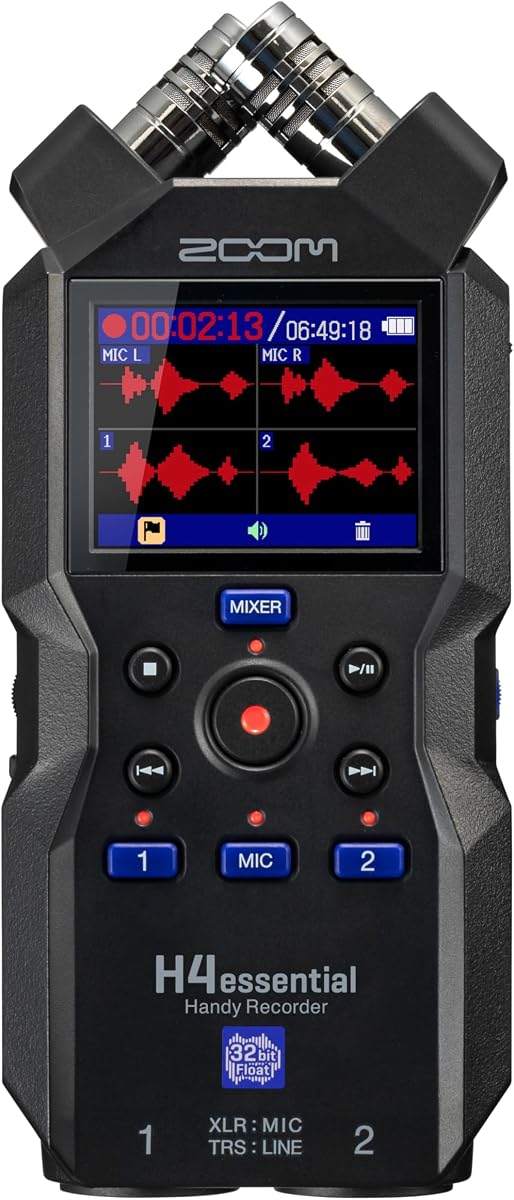
The Zoom H4 Essential is a versatile handheld recorder suitable for musicians podcasters and filmmakers. It supports 4-track recording which helps capture multiple sources without worrying about distorted takes during active sessions.
We may earn a commission when you buy through this link, at no additional cost to you.
Users can utilize built-in stereo microphones or connect external gear via XLR/TRS inputs. The ability to record to an SD card while streaming to a phone adds significant flexibility for hybrid workflows.
Spoken menu guidance makes this device accessible for visually impaired users or those new to audio recording. Clear sound capabilities cover everything from quiet dialogue to loud performances effectively.
This unit is best suited for content creators who need a balance between simplicity and functionality. It is an excellent upgrade from smartphone recording for those starting professional video or podcast projects.
Record up to four tracks simultaneously to isolate voices and ambient sound. This separation provides greater control during the editing phase of your documentary or interview project.
Connect via USB-C to record directly to mobile devices or computers. This eliminates the need for extra cables when transferring files for immediate playback or sharing.
We may earn a commission when you buy through this link, at no additional cost to you.
The Zoom F6 is a professional field recorder designed for complex filmmaking and musical needs. It captures massive dynamic range using 32-bit float technology to prevent clipping during explosive sound sequences.
We may earn a commission when you buy through this link, at no additional cost to you.
With six XLR inputs and support for up to fourteen tracks this device offers full production flexibility. Timecode I/O ensures frame-accurate sync which is vital for multi-camera shoots and broadcast workflows.
The unit is rugged enough for location work yet small enough to travel comfortably. You can use it as a standalone recorder or a USB audio interface depending on your specific setup requirements.
This recorder is recommended for professionals who need high channel counts and precise sync capabilities. It stands out as a reliable partner for any serious location sound recording task.
Timecode I/O allows you to lock audio to video frames perfectly. This reduces post-production time by ensuring tracks align automatically with picture during editing.
Use the device as a USB interface while recording to card. This dual functionality supports real-time monitoring without sacrificing the safety of a local backup file.
We may earn a commission when you buy through this link, at no additional cost to you.
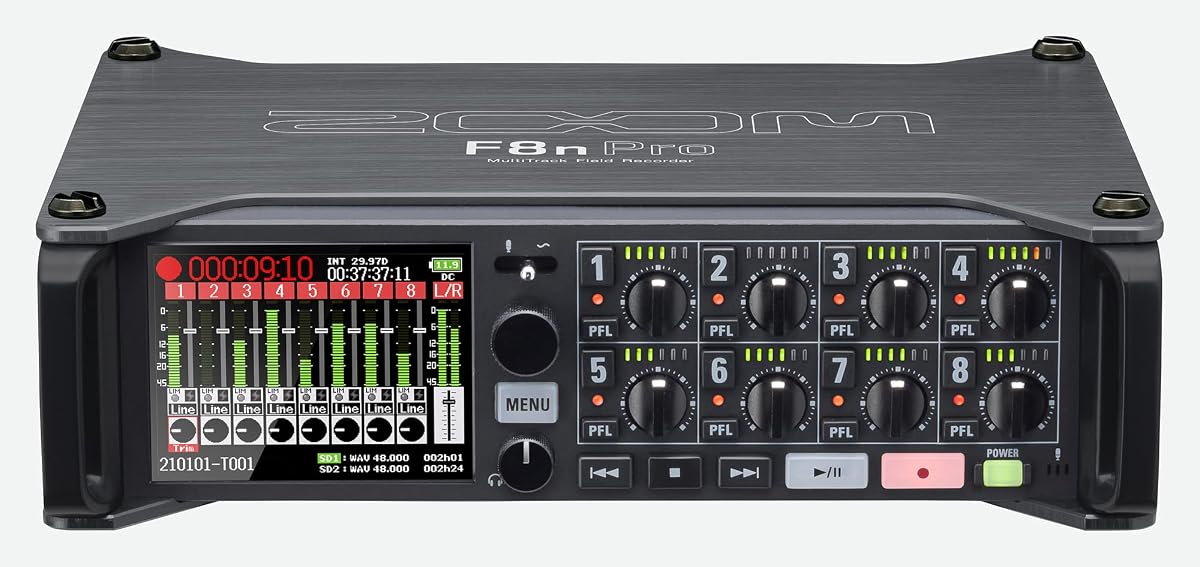
The Zoom F8n Pro is the choice for professional film and field audio work. It features an 8-channel/10-track configuration with dual AD converters to capture clip-free audio across the full dynamic range.
We may earn a commission when you buy through this link, at no additional cost to you.
High-quality preamps with up to 75dB of gain ensure pristine audio for quiet dialogue or dynamic action. Dual SD card slots allow redundant recording so you never miss a critical take on set.
Timecode accuracy down to 0.2ppm keeps tracks aligned with picture whether the recorder is on camera or off. It also functions as an 8-in/4-out USB interface simultaneously recording to card.
This device is ideal for productions requiring maximum channel capacity and reliability. It provides the flexibility and redundancy needed for high-stakes broadcasting and feature film sound departments.
Dual SD slots allow simultaneous writing to two cards. This acts as a critical backup in case one card fails during an unrepeatable live event or take.
The -127dBu EIN preamps deliver low noise even at high gain settings. This ensures clarity when capturing distant microphones in noisy outdoor environments.
We may earn a commission when you buy through this link, at no additional cost to you.
The Zoom H1 XLR is a compact 2-channel recorder offering pro-quality results with simple setup. It records in 32-bit at 96kHz ensuring clear detailed sound for interviews and everyday recording sessions.
We may earn a commission when you buy through this link, at no additional cost to you.
Two XLR/TRS combo inputs let you connect microphones and instruments easily. An OLED waveform display makes it simple to monitor levels and ensure clean recordings at a glance.
Flexibility is enhanced by 3.5mm inputs and outputs for monitoring audio or connecting external devices. Support for SDXC cards up to 1TB gives you plenty of space for extended sessions.
This recorder is perfect for beginners or situations where two inputs are sufficient. It combines ease of use with high-quality specs making it a reliable tool for quick field assignments.
The OLED display shows waveforms for immediate feedback on audio quality. You can spot clipping or low levels without needing to connect headphones constantly.
Combo inputs accept both XLR and TRS connectors. This means you can plug in balanced microphones or unbalanced instruments depending on what gear you have available.
We may earn a commission when you buy through this link, at no additional cost to you.
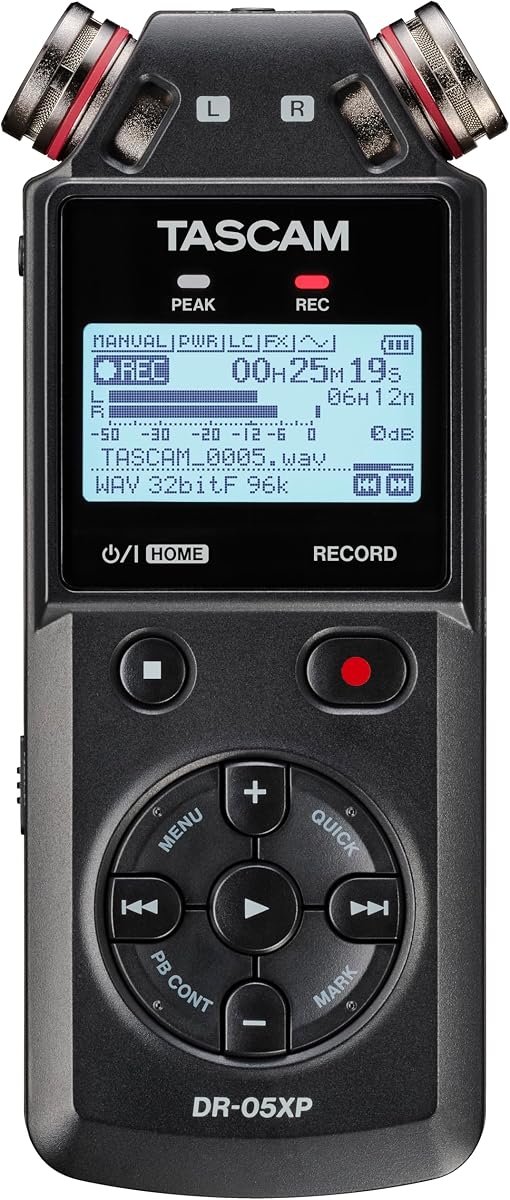
The TASCAM DR-05XP is a portable handheld recorder that captures pro-quality recordings for music and audio-for-video. It supports flexible recording modes including 32-bit float for safe capture of loud environments.
We may earn a commission when you buy through this link, at no additional cost to you.
Omnidirectional condenser microphones handle sources up to 125dB SPL without distortion. The 2-in/2-out USB-C interface allows direct recording to your computer for easy file transfer and streaming.
Battery life offers up to 17.5 hours with AA batteries ensuring you stay on set longer. It is lightweight enough to fit in a pocket yet robust enough for professional tasks.
This unit is best for run-and-gun creators needing a quick stereo solution. It is a practical tool for capturing ambient sound or quick interviews without complex setup procedures.
The internal mics are designed to handle loud sound pressure levels. This prevents distortion during live music events or noisy street scenes.
Use the USB-C port to interface directly with your PC or Mac. This turns the recorder into an audio interface for software-based recording workflows.
We may earn a commission when you buy through this link, at no additional cost to you.
The Zoom H5 is a versatile handheld recorder that uses a system of interchangeable input capsules. This allows you to change mic configurations as easily as swapping lenses on a camera.
We may earn a commission when you buy through this link, at no additional cost to you.
It includes a detachable X/Y capsule with extended signal capacity and shock mounted mics. This reduces handling noise and improves sound quality for critical audio capture in the field.
Two mic/line inputs with XLR/TRS combo connectors offer selectable phantom power and -20dB pad. Four-track simultaneous recording gives you flexibility to mix audio sources directly on the device.
The safety net feature helps protect your recordings by capturing a backup track at lower gain. It is a trusted tool for documentary filmmakers and independent musicians alike.
Swap capsules to match your recording environment. From shotgun to mid-side configurations this modularity adapts to various sound sources easily.
Safety net ensures a low gain backup is recorded alongside the main track. This provides a recovery option if unexpected loud sounds clip the primary recording.
We may earn a commission when you buy through this link, at no additional cost to you.
The TASCAM DR-10L Pro is a personal field recorder that captures superior audio with stealthy design. It supports LTC Jam Sync for seamless timecode synchronization ideal for multi-device setups.
We may earn a commission when you buy through this link, at no additional cost to you.
32-bit float recording captures everything from a whisper to a scream with pro-quality fidelity. The included TM-10L clip-on lavalier microphone is perfectly matched to deliver clear lifelike audio in busy settings.
It supports high-capacity microSDXC media cards for practically limitless storage. The CONNECT App allows master multi-unit control with up to five simultaneous recordings.
This unit is best for journalists and content creators needing discreet recording. It is a complete solution for personal audio where size and sync are critical for on-location work.
LTC Jam Sync aligns audio to video timecode precisely. This makes editing multi-camera projects significantly faster without manual alignment.
The small form factor and clip-on mic blend into the scene. Ideal for interviews where the presence of a large boom mic would distract the subject.
We may earn a commission when you buy through this link, at no additional cost to you.
The Zoom H1 Essential is designed for musicians and content creators who need better sound. It captures clear stereo audio for videos tutorials and voiceovers that need more polish than a phone alone.
We may earn a commission when you buy through this link, at no additional cost to you.
You can record songwriting sessions or rehearsals with detailed sound that is easy to capture in the moment. Natural stereo sound ensures voices come through clearly during conversations and meetings.
Connect via USB-C to use it as a microphone for livestreams and remote meetings. This bridges the gap between field recording and computer-based streaming effortlessly.
It is an affordable entry point for those improving podcast or vlog audio. The device makes recording accessible and effective for everyday content production.
USB-C connection allows direct use as a microphone for calls. This simplifies your setup for podcasts or online classes without extra interfaces.
The internal mics are tuned for natural stereo sound. This creates a more immersive listening experience for video and audio content.
We may earn a commission when you buy through this link, at no additional cost to you.
The Zoom F2 is the smallest 32-bit float recorder you can wear. It captures clip-free audio at any volume level without ever needing to adjust gain during shooting.
We may earn a commission when you buy through this link, at no additional cost to you.
It comes with the LMF-2 omnidirectional lavalier microphone featuring a screw-lock connector and windscreen. This secure discreet placement is perfect for interviews vlogs and on-camera recordings.
Running on just two AAA batteries the unit offers up to 15 hours of operation. Support for microSD cards up to 512GB provides ample storage for long-form recordings.
This recorder is ideal for journalists and videographers on the go. It combines simplicity with professional features to ensure high-quality personal audio in any setting.
The +/-0.5ppm internal clock ensures perfect audio and video sync. This level of accuracy is rare for a device of this small size.
32-bit float means you can record loud or quiet without fear. Focus on your content knowing that audio levels are handled automatically.
We may earn a commission when you buy through this link, at no additional cost to you.
Selecting the right audio field recorder requires understanding your specific workflow and production needs. This guide breaks down key factors to consider when investing in professional sound gear for film.
Consider how many microphones you need to connect simultaneously. Most professional film sets require XLR inputs for balanced microphones and the ability to handle phantom power for condensers. Ensure the device supports the number of channels you need now and in the future.
Look for models with multiple XLR inputs if you plan on recording a boom and lavaliers at the same time. Some units offer 2 inputs while others offer 8 or more for complex setups.
Dynamic range determines how well the recorder handles quiet and loud sounds together. 32-bit float recording is increasingly standard as it allows you to ignore gain staging and recover clipping in post-production. This is crucial for unpredictable environments like outdoor scenes.
Prioritize recorders that support 32-bit float if you often face loud peaks or quiet whispers. It provides a safety net that ensures clean dialogue regardless of how levels fluctuate during a take.
Timecode ensures audio stays synced with video across multiple cameras. If you shoot multi-cam productions you need a recorder with Timecode I/O to input and output sync signals. This prevents drift during long recording sessions.
Check for features like LTC Jam Sync or precision clocks. Even entry-level units should maintain accurate internal clocks to minimize post-production alignment efforts for your final cut.
Field recorders must be portable enough for location work. Consider the weight and form factor; handheld units are convenient for run-and-gun shooting while larger units offer more inputs. Power longevity is also key for long days on set.
Look for support for AA batteries or rechargeable packs. Dual battery options or the ability to run off USB-C power ensure you are not stranded in the middle of a shoot.
Storage media determines how much footage you can record before swapping cards. SDXC cards are standard and support high capacities up to 1TB or more. Redundant recording with dual slots adds a layer of safety against corruption.
Evaluate the maximum supported card size and the number of slots. Having space for multiple backup cards allows you to record continuously without stopping to transfer files.
User interface affects how quickly you can adjust settings in the field. A clear display and logical menu system are essential for monitoring levels and file management. Some units offer spoken guidance which helps visually impaired operators.
Consider if you need to interface with a computer. USB-C connectivity turns the recorder into an audio interface allowing direct control from software during post-production or livestreaming.
Rugged construction ensures reliability in harsh weather or rough handling. Look for metal chassis and reinforced connectors that withstand daily use. The device should feel sturdy enough to protect sensitive electronics.
Check reviews for real-world durability. A robust build means you can mount the unit in tight spaces without worrying about it breaking under pressure during a demanding shoot.
Balance cost with features. Entry-level units offer good stereo recording for simple tasks while premium models offer multi-channel capabilities and timecode. Determine which features are mandatory for your work versus nice-to-haves.
Investing in a recorder with room to grow prevents the need for frequent upgrades. A unit with solid specs may cost more upfront but saves money in the long run.
Always check your recording format and sample rate before a shoot. Set your device to 48kHz for video production and verify the storage card is formatted correctly. This prevents file incompatibility issues when editing your footage later.
Maintain the physical device by storing it in a protective case when not in use. Keep the XLR ports covered to prevent dust accumulation and ensure the batteries are removed during long periods of inactivity to avoid corrosion.
Regularly update the firmware on your recorder to access new features and bug fixes. Connect to your computer via USB-C and check the manufacturer's website. This ensures optimal performance and compatibility with your software.
32-bit float recording captures a massive dynamic range that prevents audio from clipping. This means you can record loud noise and quiet dialogue simultaneously without distortion. It allows you to fix gain issues in post-production rather than during the shoot.
Timecode is essential for multi-camera shoots or long takes where sync drift occurs. For simple single-camera projects, it may not be strictly necessary. However, having it ensures professional alignment between audio and video tracks regardless of complexity.
A 1TB card is often sufficient for a full day of high-resolution recording. Higher capacity reduces the need to swap cards during critical moments. Ensure your recorder supports SDXC standards to utilize large drives effectively.
Yes, they provide significantly better quality and flexibility than camera internals. They offer XLR inputs for professional microphones and better noise reduction. This results in clean dialogue that is easier to mix in post-production.
Use a recorder with timecode I/O to lock audio to the camera's timecode. If your recorder lacks this, use a clapboard or software sync tools like PluralEyes. Accurate sync prevents audio drift during long scenes.
Handheld units are ideal for run-and-gun and independent productions. Larger setups may prefer box-style units for more channels and robust features. Choose based on the complexity of your audio rig and production scale.
We reviewed ten top options ranging from compact clip-on units to professional multi-channel recorders. Each model offers unique strengths depending on your budget and specific production needs.
Prioritize features like 32-bit float and timecode if you want future-proof quality. Simpler needs may be met by handheld stereo recorders that still deliver clear results.
Always verify current availability and pricing before purchasing. Prices fluctuate but investing in quality audio ensures your film production remains professional and reliable.