
ESP32-S3-Nano Development Board
5.0Editor score
8MB PSRAM and 16MB Flash
Seamless Arduino MicroPython Switch
Compatible with IoT Cloud App
This guide compares the top Arduino Nano ESP32 boards and alternatives for IoT, Wi-Fi, Bluetooth, and embedded projects in October 2026 based on performance
The Arduino Nano ESP32 represents a significant leap in microcontroller technology, combining powerful processing with wireless connectivity. This compact board is ideal for developers seeking robust performance in a small form factor for IoT and embedded applications.
We evaluated ten leading boards based on processor power, wireless capabilities, memory, and ease of use. Our comparison covers official Arduino releases and compatible third-party options to help you find the perfect match for your specific project needs.
Each pick highlights unique strengths like USB-C support, HID profiles, or low-power modes. Please note that product availability and specific configurations can change over time so verify details before purchasing your next development board.
5.0Editor score

4.6Editor score

4.8Editor score
The following table provides a side-by-side comparison of all ten boards selected for this guide. Review the key specifications to understand how each model differs in terms of processor architecture, memory, and connectivity options.


The Arduino Nano ESP32 stands out as the top choice for developers needing a balance of official support and modern features. With a 4.6 rating, it delivers high performance thanks to the ESP32-S3 chip which supports advanced tasks like machine learning.
We may earn a commission when you buy through this link, at no additional cost to you.
Its wireless capabilities are robust with both Wi-Fi and Bluetooth 5.0 ensuring reliable connectivity. The USB-C port simplifies power delivery and programming while HID support opens doors for custom input device projects.
While it may cost more than generic clones the reliability and community support justify the investment. The MicroPython compatibility makes it accessible for those who prefer Python over C++ for rapid prototyping.
We recommend this board for serious IoT projects where stability and feature depth matter. It is the best option for developers who want official Arduino tools with the power of the ESP32-S3 architecture.
The board supports seamless communication with networks and cloud platforms making it ideal for smart home systems and remote sensors.
USB-C ensures faster programming and better power delivery while MicroPython support allows for streamlined development cycles.
We may earn a commission when you buy through this link, at no additional cost to you.
This board achieves a perfect 5.0 rating by offering exceptional value. It uses the ESP32-S3R8 chip which provides substantial memory with 8MB PSRAM and 16MB Flash for complex applications.
We may earn a commission when you buy through this link, at no additional cost to you.
Developers can switch between Arduino and MicroPython seamlessly providing flexibility in coding styles. The integration with Arduino IoT Cloud allows remote monitoring which is a significant plus for distributed projects.
The only trade-off is the lack of official Arduino branding which might matter for enterprise users. However for hobbyists and startups the cost savings and feature set are hard to beat.
We suggest this board for budget-conscious projects requiring high memory. It delivers the core benefits of the ESP32-S3 without the premium price tag of official boards.
The onboard memory resources are sufficient for running multiple libraries and handling data-intensive tasks smoothly.
Compatibility with the Arduino IoT Cloud app allows for easy monitoring and control from anywhere using a mobile device.
We may earn a commission when you buy through this link, at no additional cost to you.
This board is a powerhouse for advanced users focusing on image and voice processing. The RISC-V dual-core architecture delivers high performance while onboard MIPI interfaces allow direct connection to displays and cameras.
We may earn a commission when you buy through this link, at no additional cost to you.
It stands out with specialized hardware for JPEG encoding and image signal processing. These features make it ideal for machine learning applications at the edge where standard microcontrollers struggle.
The complexity of the board might be overwhelming for casual users but professionals will appreciate the capabilities. Security features like secure boot and flash encryption ensure robust protection for sensitive data.
We recommend this for projects involving vision systems or high-speed data processing. It represents the cutting edge of ESP32 technology with features rarely found on standard development boards.
Onboard MIPI-CSI and DSI interfaces enable direct connection to high-resolution displays and camera modules for advanced visual projects.
The RISC-V processor combined with 32MB PSRAM supports demanding tasks like real-time video analysis and complex algorithms efficiently.
We may earn a commission when you buy through this link, at no additional cost to you.
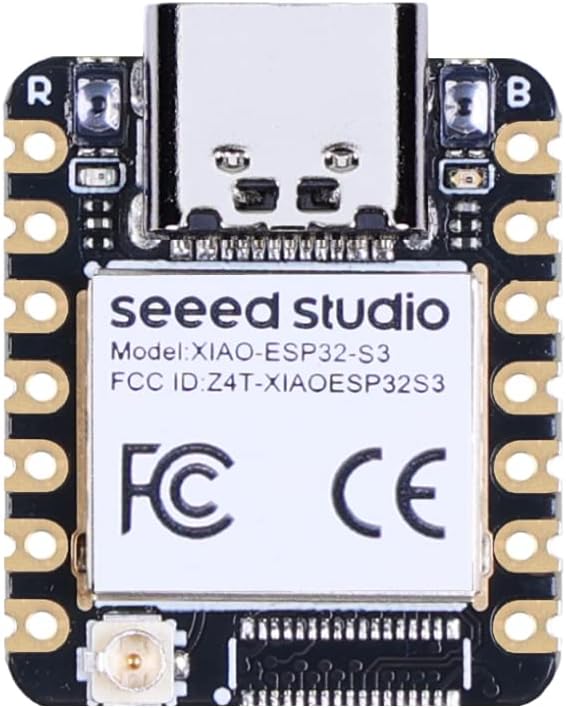
The XIAO ESP32S3 combines the power of the ESP32-S3 in a thumb-sized package. It features deep sleep modes consuming as low as 14uA making it perfect for battery-powered wearables and remote sensors.
We may earn a commission when you buy through this link, at no additional cost to you.
Its compact design is perfect for space-constrained projects where size is critical. The lithium battery charge management capability adds convenience for portable applications that need to be self-contained.
While the small size limits shield usage the rich interface support ensures you can still connect various sensors and modules. It maintains a high rating due to its reliability and power efficiency.
We suggest this board for wearable tech and portable IoT devices. The combination of power efficiency and wireless connectivity makes it a standout choice for mobile projects.
Four power consumption models allow for deep sleep modes which extend battery life significantly for remote monitoring applications.
The 21 x 17.5mm form factor fits into tight spaces making it ideal for wearable devices and small robotic components.
We may earn a commission when you buy through this link, at no additional cost to you.
This kit provides three boards which is excellent for testing multiple nodes in a distributed IoT system. The ESP32-S3FH4R2 module offers solid performance with dual-core processing and integrated ceramic antenna for stable connectivity.
We may earn a commission when you buy through this link, at no additional cost to you.
The castellated edges allow direct soldering to carrier boards making it suitable for custom PCB designs. Independent power supply settings give developers control over power consumption in different scenarios.
While the flash memory is lower than premium options it suffices for most wireless sensor tasks. The three-pack pricing offers great value for prototyping fleets of devices.
We recommend this for projects requiring multiple nodes or custom PCB integration. The flexibility and cost-efficiency make it a strong contender for scaling IoT deployments.
Getting three boards in one package is ideal for testing distributed systems or building arrays of connected sensors.
Castellated module design enables direct soldering to carrier boards which simplifies custom PCB design and manufacturing.
We may earn a commission when you buy through this link, at no additional cost to you.
This kit is designed for those new to ESP32 development. It includes over 35 components like sensors and motors so you can build a variety of projects without buying extra parts.
We may earn a commission when you buy through this link, at no additional cost to you.
The included tutorials provide clear instructions and code examples which helps beginners learn electronics and coding basics. Compatibility with the Arduino IDE ensures it is easy to start programming immediately.
While it lacks newer features like Bluetooth 5.0 it is perfect for mastering the fundamentals. The structured learning path makes it a valuable resource for students and hobbyists.
We suggest this kit for anyone starting their journey with IoT. The comprehensive nature of the package ensures you have everything needed to experiment and learn effectively.
The included step-by-step tutorials offer a solid foundation for understanding electronics and programming without prior experience.
With over 35 modules and components the kit covers sensors, displays, and motors allowing for diverse project experimentation.
We may earn a commission when you buy through this link, at no additional cost to you.
The Nano 33 IoT focuses on secure cloud connectivity. It includes a Secure Element which ensures hardware-level encryption for safe data transmission and privacy in sensitive applications.
We may earn a commission when you buy through this link, at no additional cost to you.
While the processor is less powerful than the ESP32-S3 it is efficient for standard IoT tasks. The inclusion of built-in sensors like accelerometer and gyro adds value for motion tracking projects.
The trade-off is lower raw processing power which might limit complex applications. However for reliable wireless data transmission it remains a solid choice for commercial and industrial use.
We recommend this for security-conscious projects requiring reliable connectivity. Its proven stability and security features make it a trusted option for professional deployments.
The u-blox Secure Element provides advanced encryption ensuring your project remains secure and private.
Built-in sensors allow for easy integration of motion and environmental data without external components.
We may earn a commission when you buy through this link, at no additional cost to you.
This board is a classic choice for ESP32 projects with a solid track record. The three-pack offers good value for prototyping while the RF filtering ensures stable wireless performance.
We may earn a commission when you buy through this link, at no additional cost to you.
It supports AP and STA modes allowing flexible network configurations. The ultra-low power modes are beneficial for battery operated devices that need to conserve energy during idle times.
While newer boards have better connectivity options this one remains reliable for standard tasks. The lack of USB in the package requires you to use an existing cable for programming.
We suggest this for standard IoT prototypes where cost is a factor. Its reliability and compatibility with existing libraries make it a dependable choice for general use.
Integrated antenna and RF filtering ensure stable Wi-Fi and Bluetooth performance in various environments.
Support for AP STA and AP+STA modes allows versatile networking setups including direct device to device communication.
We may earn a commission when you buy through this link, at no additional cost to you.
These boards offer a modern USB-C port which is increasingly common in development environments. The over-the-air update support means you can push firmware changes without physically reconnecting to the board.
We may earn a commission when you buy through this link, at no additional cost to you.
With a 4.7 rating users appreciate the reliability and the ease of use. The three-pack allows for building a small cluster of sensors or testing multiple setups at once.
The main limitation is the older Bluetooth version which might not work with newer peripherals. For Wi-Fi focused projects this remains a strong option given the USB-C convenience.
We recommend this for hobbyists who need modern connectivity options. The OTA support simplifies maintenance and updates for deployed devices.
The USB-C port provides a modern connection option for programming and power delivery which simplifies cable management.
OTA functionality allows for wireless firmware updates saving time on physical maintenance after deployment.
We may earn a commission when you buy through this link, at no additional cost to you.
The UNO R4 WiFi combines a Renesas RA4M1 with ESP32-S3 for dual-core processing power. This is ideal for industrial applications requiring reliable communication via CAN bus alongside standard Wi-Fi.
We may earn a commission when you buy through this link, at no additional cost to you.
Additional features like the 12-bit DAC and Qwiic connector make it versatile for precise analog tasks and sensor integration. The built-in LED matrix provides immediate visual feedback for status monitoring.
While it is larger than a Nano it offers robust features not found on smaller boards. The higher price reflects these advanced capabilities and the official support backing.
We suggest this for complex industrial projects needing CAN bus and high precision analog. It is a powerful upgrade for those moving beyond standard prototyping needs.
Support for CAN bus allows reliable real-time communication essential for automotive and industrial automation systems.
The built-in 12×8 LED matrix enables immediate visual feedback for status indicators and data display on the board itself.
We may earn a commission when you buy through this link, at no additional cost to you.
Choosing the right board depends on your project needs and technical requirements. Consider these factors to make an informed decision.
Look for boards with the ESP32-S3 or newer architectures for better performance and AI support. Dual-core processors running at 240MHz handle complex tasks like voice recognition efficiently.
Prioritize newer chips if your project involves machine learning or intensive data processing.
Check the amount of Flash and PSRAM available. Boards with 8MB PSRAM and higher Flash allow for running multiple libraries and handling larger projects smoothly.
Ensure memory is sufficient for your code size and data logging needs.
Bluetooth 5.0 offers better range and power efficiency than older versions. Wi-Fi 6 support is a bonus for high-density networks but standard Wi-Fi is often sufficient.
Select boards with Bluetooth 5.0 for newer device compatibility and better power management.
USB-C ports provide faster programming and reliable power delivery. Older micro-USB ports may still be common but are less convenient for modern setups.
Choose USB-C for ease of use and future-proofing your development workflow.
Hardware security elements ensure data encryption and secure boot. This is critical for projects handling sensitive data or connecting to public networks.
Verify if the board includes Secure Element or flash encryption features.
Deep sleep modes and low power consumption are vital for battery operated devices. Look for boards with power management features to extend battery life.
Prioritize low power design for wearables and remote sensors.
Nano sizes save space but limit shield usage. Choose between compact designs like XIAO and standard sizes based on your physical constraints.
Consider the physical size and mounting options for your final product.
Official Arduino boards offer stable IDE support while clones may vary. Check compatibility with MicroPython if you prefer Python for coding.
Ensure the board works well with your preferred development environment.
Install the latest Arduino IDE or compatible editor before connecting the board. Ensure you have the necessary drivers installed for USB-C connectivity to avoid connection issues.
Avoid exposing the board to excessive heat or moisture during operation. Use heat shrink or protective cases for outdoor projects to maintain longevity and reliability.
Regularly update firmware to benefit from security patches and new features. Use the built-in OTA support if available to update devices wirelessly after deployment.
Yes the official Arduino Nano ESP32 is fully compatible with the Arduino IDE. This allows you to use existing libraries and examples seamlessly for faster development and easier programming.
Many boards in this guide support MicroPython including the Nano ESP32 and several compatible models. This provides a simpler coding experience for those who prefer Python over C++ for prototyping.
Bluetooth 5.0 offers improved speed range and power efficiency compared to 4.2. For newer devices and better battery life boards with 5.0 support are generally recommended for modern projects.
You can power the board via USB-C or an external power source connected to the VIN pin. Ensure the voltage stays within the recommended range to prevent damage to the board.
Clones can be more cost-effective for bulk production but official boards offer better quality control and support. Evaluate the trade-off between cost and reliability for your specific needs.
Most boards in this guide have onboard antennas sufficient for typical indoor ranges. External antennas are only required for extreme distances or specialized RF environments.
High-end models like the ESP32-P4-NANO are designed for image processing with specialized hardware. Standard ESP32 boards can handle basic tasks but may struggle with complex visual data.
The ELEGOO Starter Kit provides a complete package with tutorials ideal for beginners. Alternatively the official Nano ESP32 offers strong support to help you learn effectively.
We highlighted the official Nano ESP32 as the top choice for balanced performance and support. The budget option provides excellent value while the premium board excels at advanced multimedia tasks.
Consider your project requirements like power consumption or memory before deciding. Choosing the right form factor and connectivity options will ensure your project succeeds without unnecessary complications.
Please check current availability and details before purchasing as specifications may change over time. Verify compatibility with your existing tools and components to ensure a smooth development process.