
6-Band Signal Generator 100KHz-150MHz
4.5Editor score
100KHz to 150MHz range
Low phase noise design
Simple front panel layout
This guide compares the top Amfm Signal Generator options for radio testing and lab work, evaluating features, modulation types, and signal quality.
Finding the right Amfm Signal Generator is essential for engineers and hobbyists who need precise frequency modulation for testing circuits. A good generator offers stable output, clear modulation control, and reliable performance across various frequency bands without unnecessary complexity or cost.
We compared ten models based on frequency range, modulation capabilities, build quality, and user feedback to help you choose wisely. Each product was evaluated for its ability to deliver accurate signals for radio equipment maintenance, lab experiments, and electronic diagnostics in professional settings.
Each pick highlights key strengths and limitations so you can match a device to your specific needs. Prices and availability change frequently, so verify current details before purchasing. Our goal is to provide clear, factual insights to support your decision-making process.
4.5Editor score

5.0Editor score

4.2Editor score
This side-by-side comparison highlights key specifications across all ten models to help you identify the right tool for your testing needs.



The UNI-T UTG962E stands out as a top performer with a 60 MHz frequency range and dual channel capability. It achieves a perfect 5.0 rating based on its high performance and compact design that fits easily in a palm. Users appreciate its versatility for diverse applications in labs or field testing.
We may earn a commission when you buy through this link, at no additional cost to you.
Its key strengths include advanced modulation types like AM, FM, PM, and FSK which provide broad testing options. The device supports sine, square, ramp, pulse, noise, DC, and arbitrary waveforms with deep memory. This ensures precise signal generation for complex circuit analysis without needing extra tools.
Trade-offs include a higher cost compared to basic generators and a learning curve for first-time users. However, these are acceptable given the professional-grade features and portability. The included power adapter and cables reduce setup time and make it ready for immediate use.
Electronics enthusiasts and professionals needing reliable signal generation should consider this device for its balanced performance. It delivers accurate results for radio equipment maintenance and educational projects. This recommendation holds true for those seeking quality without excessive bulk.
AM, FM, PM, and FSK modulation types allow flexible testing across different signal environments.
Mini palm-sized design ensures easy transport to work sites or field testing locations.
We may earn a commission when you buy through this link, at no additional cost to you.
The OWON DGE2035 offers high precision with 35 MHz output and 14-bit resolution for stable signal generation. It earned a 4.2 rating due to its dual-channel support and clear TFT LCD for real-time status. This makes it suitable for research labs and educational training where accuracy is critical.
We may earn a commission when you buy through this link, at no additional cost to you.
Key strengths include 150 built-in arbitrary waveforms and multiple standard types like sine and square. The device supports remote control via USB for integrated testing workflows. Its ultra-thin design and shortcut keys simplify operation for engineers needing consistent results.
The frequency range is lower than some competitors but still ample for many applications. The price point reflects advanced features that may not suit all hobbyist budgets. These trade-offs are acceptable for users prioritizing resolution and programmability over raw bandwidth.
Engineers and educators requiring precise waveform control will find this generator reliable. It performs well for industrial testing and electronics development. Consider this model if you value detailed resolution and PC integration in your lab setup.
The 3.6 inch TFT LCD displays waveform status and settings clearly for easier monitoring.
USB connectivity enables PC control for automated or integrated testing sequences.
We may earn a commission when you buy through this link, at no additional cost to you.
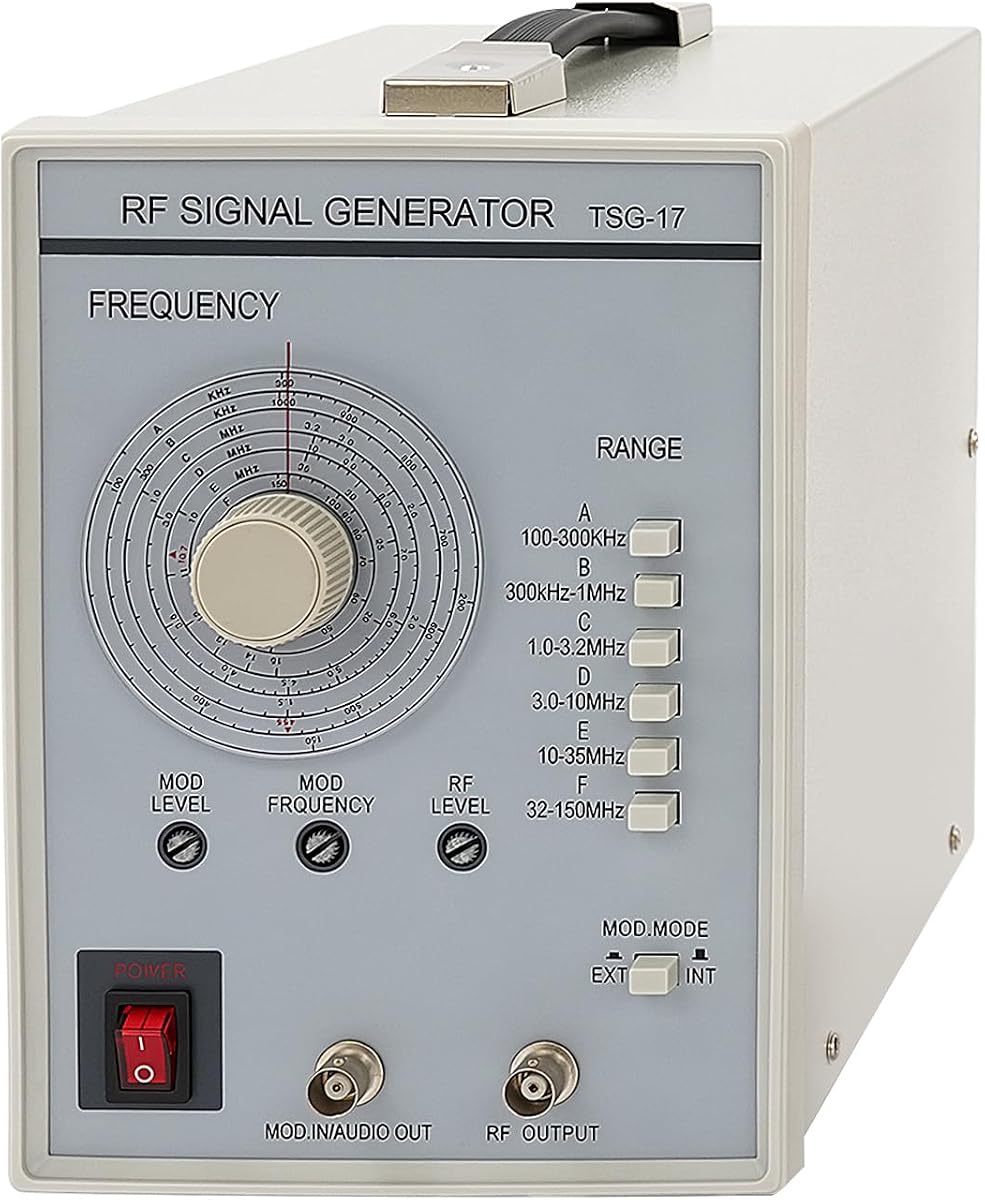
This 6-Band Signal Generator delivers a wide frequency range from 100KHz to 150MHz at an affordable price. It maintains a solid 4.5 rating based on its low phase noise and durable construction. Users find it practical for radio testing and equipment maintenance without complex controls.
We may earn a commission when you buy through this link, at no additional cost to you.
Its main strengths include multiple modulation methods like AM and FM for flexible signal generation. The front panel features clear markings and convenient knobs for quick start. Assembly-free design means you only need power and test clips to begin operations immediately.
Trade-offs include limited advanced features compared to high-end models. It lacks arbitrary waveform capabilities which may restrict complex testing scenarios. These limitations are acceptable for users needing reliable basic signal output for common tasks.
Hobbyists and maintenance technicians needing a straightforward tool should consider this option. It provides essential functionality for testing environments with high signal quality requirements. This model balances cost and performance well for routine electronic diagnostics.
High-class metal and plastic spraying ensure scratch-resistant and impact-resistant longevity.
Clear front panel layout and convenient knobs help users get started quickly.
We may earn a commission when you buy through this link, at no additional cost to you.
The Upgraded RF Signal Generator offers an extended frequency range from 35MHz to 4400MHz for diverse uses. It holds a 3.7 rating reflecting mixed user experiences with its waveform quality. The device includes single frequency and sweep modes for flexibility in testing different signal types.
We may earn a commission when you buy through this link, at no additional cost to you.
Its strengths include memory retention for previous frequencies after power off and USB power compatibility. The wide range supports applications beyond standard RF testing. Convenience is enhanced by mobile charger or power bank compatibility for field work.
Trade-offs involve waveform purity with some noise present on sine outputs. User ratings suggest inconsistent quality compared to premium models. These issues may be acceptable for basic signal needs where range and cost are prioritized.
Users needing broad frequency coverage for experimentation should evaluate this device carefully. It serves as an entry-level tool for varied applications. Consider your tolerance for waveform noise before committing to this model.
Supports single frequency and sweep modes for broader testing scenarios.
Can be powered via mobile charger or power bank for field use.
We may earn a commission when you buy through this link, at no additional cost to you.
The TSG-17 High Frequency generator provides a traditional design with 100kHz to 150MHz output. It has a 2.5 rating indicating limitations in performance or usability compared to modern options. It includes a power cord and supports external modulation for basic signal adjustments.
We may earn a commission when you buy through this link, at no additional cost to you.
Its main strengths include stable 110V power compatibility and adjustable output control from 1mV to 100m. External modulation can be set between 50Hz to 20 KHz for varied testing. This fits commercial and household needs where simplicity is valued.
Trade-offs involve limited waveform support beyond sine and amplitude modulation. User ratings suggest potential issues with reliability or clarity. These factors make it less ideal for complex lab environments needing precise arbitrary signals.
Users needing a basic high frequency tool with stable power should consider this option. It remains useful for specific AM radio testing scenarios. Evaluate alternatives if higher precision or waveform variety is required.
Includes power cord for consistent 110V operation without battery dependency.
Supports external signals from 50Hz to 20 KHz for flexible adjustments.
We may earn a commission when you buy through this link, at no additional cost to you.
The Adjustable Signal Generator provides flexible voltage and current outputs with built-in battery power. It holds a 4.1 rating due to its portable design and protection features. Users value the ability to set voltage and current precisely for debugging tasks.
We may earn a commission when you buy through this link, at no additional cost to you.
Its strengths include 4-20mA current settings and 0-12V voltage control with calibration accuracy. PWM output allows frequency and duty cycle adjustments for specific signal needs. Charging indicators and automatic stop features ensure safe battery management.
Trade-offs include limitations on 12V system compatibility due to low level constraints. The focus on current and voltage reduces high frequency signal generation capabilities. These restrictions are acceptable for industrial panel and PLC testing instead of RF work.
Technicians needing portable voltage and current simulation should find this generator useful. It supports device testing without external power supplies. Consider it for control system debugging where precise analog outputs are required.
1500mAh lithium battery enables portable use without constant external power.
Voltage and current settings are adjustable with calibration for accuracy.
We may earn a commission when you buy through this link, at no additional cost to you.
The Riiai 0-10V generator combines voltage and current output in a compact design. It earned a 4.6 rating based on its clear 4-digit display and easy rotary control. Users appreciate the versatility for PLC and panel debugging tasks.
We may earn a commission when you buy through this link, at no additional cost to you.
Its strengths include precision of 0.01V and 0.01mA with calibration options. The device can switch display modes between voltage, current, and percent values. A rechargeable battery or external power supports flexible use in field or lab settings.
Trade-offs include a focus on low frequency analog signals rather than RF waves. The display is small compared to larger TFT screens on premium units. These limitations are acceptable for technicians needing fast, portable analog signal testing.
Technicians debugging control systems will find this generator convenient for quick checks. It supports flow valves, light dimmers, and motor speed regulation. Consider this option for its portability and precision in analog testing.
Rotary encoder provides precise 0.01V and 0.01mA adjustment for accuracy.
Nine fast signal output points speed up common testing sequences.
We may earn a commission when you buy through this link, at no additional cost to you.
The Riiai SG003A serves as a feature-rich analog simulator with multiple signal types. It holds a 4.4 rating due to its large TFT screen and long battery life. Users find it efficient for PLC testing with real-time curve display.
We may earn a commission when you buy through this link, at no additional cost to you.
Its strengths include precision conversion for voltage and current plus pulse signals. The adjustable backlight and programmable auto modes simplify repetitive testing tasks. A 3000mAh battery supports up to 26 hours of operation between charges.
Trade-offs include a learning curve for managing multiple signal interfaces. The device focuses on analog simulation rather than RF waveform generation. These factors are acceptable for industrial technicians needing comprehensive signal versatility.
Professionals handling control systems will benefit from its programmable features and display. It covers passive and active signal conversion for varied tests. Consider this generator for advanced PLC and industrial debugging scenarios.
3000mAh capacity supports up to 26 hours of continuous operation.
Auto modes allow monotonous rise, fall, or cycle outputs for automation.
We may earn a commission when you buy through this link, at no additional cost to you.
The DROK 4-20mA generator uses a simple potentiometer for analog signal control. It received a 4.3 rating based on its ease of use and dual output capability. Users prefer its straightforward design for PLC and LED panel testing.
We may earn a commission when you buy through this link, at no additional cost to you.
Its main strengths include single module generation of current and voltage signals. The multi-cycle potentiometer allows precise adjustments without digital menus. This simplicity reduces setup time and learning effort for technicians in the field.
Trade-offs include lack of digital display for exact value readout. Manual control may be slower for frequent adjustments compared to digital units. These limitations are acceptable for users prioritizing quick access to basic analog signals.
Technicians needing portable analog simulation without digital complexity should consider this model. It supports value adjustment and panel debugging efficiently. Choose this for simple, reliable current and voltage testing tasks.
Multi-cycle potentiometer enables precise manual adjustment without menus.
Handy single module fits easily in a toolkit for field use.
We may earn a commission when you buy through this link, at no additional cost to you.
The SEESII Dual Channel generator offers fully independent equal-performance channels for precise testing. It earned a perfect 5.0 rating based on its high precision and integrated instrument functions. Users value its 30MHz DDS signal range and arbitrary waveform support for simulations.
We may earn a commission when you buy through this link, at no additional cost to you.
Key strengths include phase difference adjustment and 60 preset arbitrary waveforms for varied demands. The TFT LCD displays real-time waveforms clearly for easy configuration. It combines seven devices into one to save space and reduce equipment costs.
Trade-offs include a lower max frequency than some RF-focused competitors. Advanced features require time to learn for full utilization. These are acceptable for students and engineers needing versatile testing in a single device.
Students and R&D engineers needing a versatile lab tool should consider this generator. It supports design competitions and electronic inspection with high accuracy. Choose this model for its all-in-one value and dual channel flexibility.
Equal-performance channels allow same or different waveforms with phase control.
Combines function, pulse, noise, and frequency meter into one device.
We may earn a commission when you buy through this link, at no additional cost to you.
Selecting the right Amfm Signal Generator requires understanding your specific testing needs and technical constraints.
The frequency range defines the signals your generator can produce, typically from kHz to MHz. For RF and AM/FM testing, ensure the device covers the target band like 150MHz or higher for broader applications. Narrow ranges suit specific tasks but limit flexibility for future projects.
Verify the minimum and maximum output frequencies match your equipment specifications before purchase.
Modulation types such as AM, FM, PM, and FSK determine how signals are varied for testing. Look for generators supporting the modulation methods needed for your radio or circuit analysis tasks. Advanced units may also offer pulse or arbitrary waveform modulation for complex scenarios.
Confirm the modulation options align with your testing requirements to avoid purchasing an under-featured model.
Resolution and accuracy impact signal purity and measurement reliability in professional environments. Higher bit resolution like 14-bit ensures precise waveform generation with minimal distortion. Accuracy specifications help predict test result consistency across different applications.
Choose devices with higher resolution if your work demands exact signal reproduction for quality control.
Channel count refers to how many signals the generator can output simultaneously. Dual channel units allow testing differential circuits or comparing signals without extra tools. Single channel models suffice for basic tasks but limit multitasking capabilities.
Select dual channel generators if your projects require synchronized or independent signal outputs.
Portability matters for field work, so compact designs and battery operation are valuable. Look for rechargeable batteries or USB power compatibility to extend usage without outlet access. Consider weight and size when choosing devices for transport to remote sites.
Prioritize units with battery options if you need to test equipment outside fixed lab environments.
Connectivity options like USB enable PC control for automated workflows and data logging. Check for software support that allows remote operation to integrate with existing lab setups. Some models include additional interfaces for external modulation or synchronization.
Opt for USB-enabled models if you require remote control or integration with testing software.
Build quality affects longevity, so look for sturdy materials like metal or reinforced plastic. Impact-resistant designs reduce risk of damage during transport or daily use in busy labs. Clear markings and knobs improve usability and reduce wear on controls.
Invest in devices with durable construction to ensure reliable performance over long-term use.
Price reflects feature set and quality, so balance budget against necessary capabilities. Higher cost models often provide better accuracy, range, and support. Evaluate if extra features justify the price difference for your specific usage patterns.
Choose a model that offers the best combination of features and price for your needs.
Start by connecting the generator to a stable power source or charging the battery if portable. Ensure all cables are securely attached to avoid signal loss during testing. Adjust the frequency and modulation settings according to your equipment specifications before powering on.
For daily use, calibrate the output to maintain accuracy over time. Check the display for real-time waveform status and adjust amplitude or phase as needed. Always store settings properly when shutting down to resume quickly next time.
Clean the device with a soft dry cloth to remove dust without scratching surfaces. Avoid exposure to moisture or extreme temperatures that could damage internal components. Regularly inspect cables and connectors for wear to prevent connection issues.
An Amfm Signal Generator produces specific radio frequency signals for testing and troubleshooting electronic equipment. It helps verify receiver performance, tune circuits, and validate modulation techniques. These devices are essential in labs, manufacturing, and field maintenance.
Yes, many models support AM/FM modulation and frequencies common to radio repair tasks. They allow precise signal injection to diagnose issues in receivers. Always check the frequency range matches the radio's operating band before use.
Analog generators use traditional circuits to produce signals, while digital ones use synthesized waveforms for better precision. Digital models often offer arbitrary waveforms and easier control. Choose based on the level of customization and accuracy you require.
Yes, periodic calibration ensures output accuracy remains consistent over time. Many models include self-check features but external calibration may be needed for critical applications. Follow manufacturer guidelines for calibration intervals and procedures.
Choose single channel for basic signal generation tasks that do not need simultaneous outputs. Dual channel models are better for comparing signals or testing differential circuits. Your choice depends on the complexity of your testing requirements.
Yes, many models are designed with user-friendly interfaces ideal for teaching electronics. They provide safe signal levels and clear displays to demonstrate concepts. Look for ones with multiple waveform options to support varied curriculum needs.
Most units include power adapters, USB cables, and basic test cables. Some packages also provide alligator clips or manuals for setup. Check the specific listing to confirm included accessories before purchasing.
Many models feature non-volatile memory that saves settings after power off. Use the memory or save function to store frequently used configurations. This allows quick recall without re-entering parameters each session.
We highlighted the UNI-T UTG962E, 6-Band Signal Generator, and OWON DGE2035 as top performers based on features and ratings. Each offers distinct advantages for different testing scenarios ranging from field work to lab precision. These models balance cost, reliability, and performance effectively.
Prioritize your specific needs like frequency range and modulation types when making your final decision. Higher resolution and connectivity features may justify higher costs for professional environments. Consider portability if you work across multiple sites regularly.
Remember to verify current prices and availability before purchasing since market conditions change frequently. Reading updated reviews and checking warranty details adds confidence to your choice. Selecting the right generator ensures accurate results and reliable long-term performance.