
Bingfu Dual Band WiFi Antenna
4.6Editor score
Dual band 2.4GHz and 5GHz support
RP-SMA Male connector included
Pack of two antennas provided
This guide compares the top antenna for router options to help you find the best model for your home or office wireless network setup today.
Finding the right antenna for router setups is crucial for maintaining strong wireless signals throughout your home or office. Modern devices require reliable connectivity to handle streaming, gaming, and remote work without interruptions or drops.
We evaluated ten top-rated products based on signal gain, compatibility, build quality, and user feedback. Each option was reviewed to ensure it meets the diverse needs of different networking environments and device configurations effectively.
Each pick highlights specific strengths and ideal use cases to help you make an informed decision. Prices and availability can change quickly, so verify details on the product page before finalizing your purchase order.
4.6Editor score
4.5Editor score

4.4Editor score
Below is a side-by-side comparison of all ten products reviewed in this guide. Each entry highlights key specifications and compatibility details to help you identify the right fit for your specific networking hardware and needs.


The Bingfu Dual Band WiFi Antenna offers excellent value for users seeking basic signal enhancement. With a 4.6 rating, this pack delivers dual band coverage across 2.4GHz and 5GHz frequencies for broad device compatibility.
We may earn a commission when you buy through this link, at no additional cost to you.
Its 3dBi gain provides stable connections for everyday tasks like browsing and video calls. The RP-SMA Male connector ensures it fits most standard routers and wireless cards easily without needing adapters.
While the gain is modest compared to high-performance outdoor options, it suffices for indoor setups. The compact size allows flexible placement near windows or on desks without cluttering your workspace.
This antenna is ideal for budget-conscious users needing reliable connectivity. It suits those upgrading older routers or adding antennas to security cameras and IoT devices with standard RP-SMA ports.
Works with routers, adapters, and cameras for seamless network expansion.
Simple plug-and-play setup with standard connectors for quick deployment.
We may earn a commission when you buy through this link, at no additional cost to you.
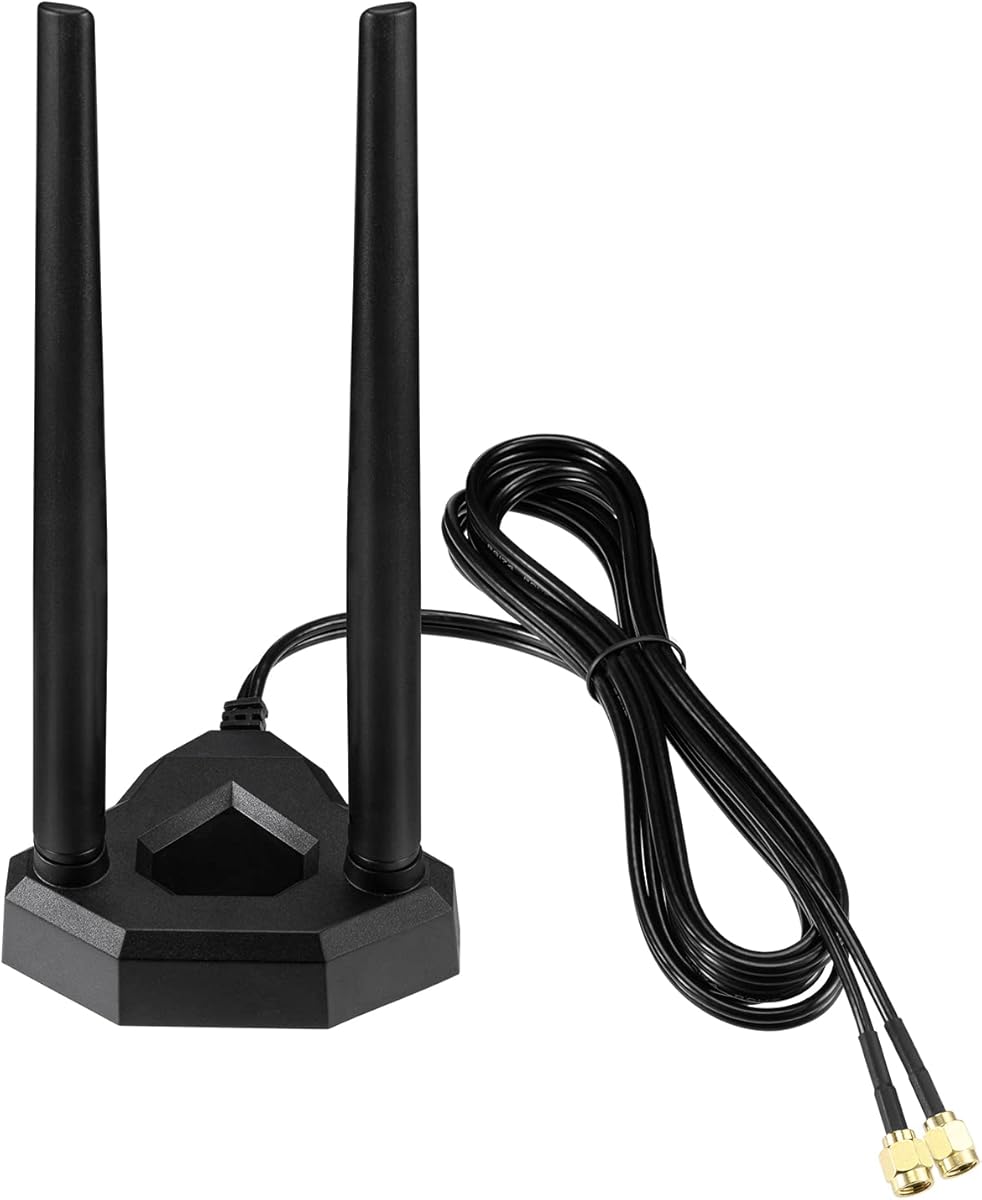
Eightwood's Dual Band Antenna stands out for its robust performance and user-friendly features. Rated 4.5, it supports modern Wi-Fi 6 networks while maintaining strong signals across multiple devices simultaneously.
We may earn a commission when you buy through this link, at no additional cost to you.
The 6.5ft extension cable lets you place the antenna in optimal spots away from metal interference. A magnetic base simplifies vertical mounting on steel surfaces for improved reception in busy environments.
While designed for indoor use, its stability reduces network drops during high-load activities. The omnidirectional pattern ensures consistent coverage without requiring precise angular adjustments for every device.
Choose this antenna for reliable indoor connectivity with easy placement flexibility. It fits best in homes or offices where positioning near windows or high points enhances overall wireless performance effectively.
Cable length allows strategic placement to avoid obstructions and boost speed.
Compatible with latest Wi-Fi 6 standards for future-ready network upgrades.
We may earn a commission when you buy through this link, at no additional cost to you.
This tri-band antenna delivers premium performance for advanced users with Wi-Fi 6E routers. It supports the new 6GHz band, offering reduced interference and faster speeds for demanding tasks like 4K streaming.
We may earn a commission when you buy through this link, at no additional cost to you.
With a 4.4 rating, it ensures stable connections even with multiple devices active. The 6.5ft cable and magnetic base allow flexible positioning to maximize coverage in complex home layouts.
The higher cost is justified by its cutting-edge support for modern protocols. It eliminates congestion on traditional bands, making it perfect for gaming setups or smart home hubs needing reliable throughput.
Invest in this antenna if you own a compatible router and seek top-tier speed. It transforms network potential by unlocking the full bandwidth of your wireless infrastructure seamlessly.
Provides extra spectrum for less interference and faster device communication.
Reduces latency significantly for competitive online play and real-time apps.
We may earn a commission when you buy through this link, at no additional cost to you.
Designed for outdoor expansion, this antenna boosts range with a 7dBi gain. It handles dual band frequencies to extend connectivity to sheds or outdoor cameras without sacrificing stability.
We may earn a commission when you buy through this link, at no additional cost to you.
Though rated 3.6, users note improved signal in remote areas. The included bracket and screws simplify wall mounting, making it practical for permanent installations on homes or fences.
Cable length of 3 meters helps route connections cleanly indoors. Its weather-resistant build protects against elements, ensuring longevity in exposed positions unlike standard indoor antennas.
Select this antenna for outdoor projects requiring extended reach. It serves as a cost-effective solution to bridge gaps between main routers and distant devices securely.
Higher gain pushes signals further than standard indoor units effectively.
Built to withstand outdoor conditions for long-term outdoor use.
We may earn a commission when you buy through this link, at no additional cost to you.
Superbat offers a competitive tri-band antenna with Wi-Fi 6E support at a lower price. It delivers improved speeds and less congestion for modern networks needing extra bandwidth capacity.
We may earn a commission when you buy through this link, at no additional cost to you.
Rated 4.3, users appreciate the magnetic base for quick adjustments. The 6ft cable provides reasonable reach while maintaining signal integrity over distance without significant degradation.
Its design ensures compatibility with standard RP-SMA ports on routers. While shorter than some competitors, it suffices for most indoor placements where flexibility is key.
Ideal for tech enthusiasts seeking 6GHz benefits without premium costs. This antenna balances performance and price, making advanced Wi-Fi accessible for average home setups.
Provides high-speed 6GHz access with stable dual-band fallback options.
Magnetic base allows non-permanent placement adjustments quickly.
We may earn a commission when you buy through this link, at no additional cost to you.
This Eightwood model features a tall 8.6-inch design for strong indoor signal. With 6dBi gain, it outperforms standard 3dBi antennas for rooms with multiple obstructions or walls.
We may earn a commission when you buy through this link, at no additional cost to you.
The 4.5 rating reflects reliable performance across dual bands. The 6.5ft cable helps position the antenna vertically near ceilings or high shelves for optimal reach.
Supporting Wi-Fi 6 ensures compatibility with newer routers. Its omnidirectional pattern distributes signals evenly without needing precise alignment for different device directions.
Choose this antenna for indoor spaces requiring extra height. It suits large homes where elevation boosts coverage better than low-profile alternatives in corners.
Increased height improves signal line-of-sight over furniture and obstacles.
Supports modern standards for faster speeds and better efficiency.
We may earn a commission when you buy through this link, at no additional cost to you.
With a 9dBi gain, this antenna excels in extending range for cameras. Rated 4.7, it handles dual bands to ensure stable feeds even in remote outdoor locations.
We may earn a commission when you buy through this link, at no additional cost to you.
Built to withstand outdoor conditions, it reduces connection drops for security setups. The omnidirectional design maintains connectivity despite device movement or environmental changes.
Its simple replacement process enhances existing systems without new hardware. The high gain might need careful alignment to avoid overloading nearby devices improperly.
Optimal for security cameras or RVs needing long-distance links. This antenna guarantees reliable transmission where standard units struggle due to distance or barriers.
9dBi gain delivers strongest signal among reviewed indoor options.
Designed for exterior conditions to ensure continuous operation.
We may earn a commission when you buy through this link, at no additional cost to you.
TRENDnet provides a business-grade kit with N-Type connectors for secure installs. Rated 4.5, it supports tri-band frequencies, making it versatile for complex networks needing robust links.
We may earn a commission when you buy through this link, at no additional cost to you.
Its outdoor rating ensures operation across extreme temperatures. The kit includes two antennas for MIMO setups, enhancing throughput in high-demand environments like offices.
While N-Type connectors require specific routers, they offer better stability. Compliance with standards adds trust for public or enterprise projects needing reliable infrastructure.
Select this for commercial setups requiring professional hardware. It suits organizations prioritizing durability and future-proofing over consumer-grade convenience options.
N-Type connectors ensure firm connections for high-performance needs.
Operates in wide temperature ranges for harsh outdoor environments.
We may earn a commission when you buy through this link, at no additional cost to you.
This antenna is designed for NETGEAR mobile hotspots. Rated 3.9, it supports 5G and LTE bands to enhance connectivity in areas with weak cellular coverage.
We may earn a commission when you buy through this link, at no additional cost to you.
Its slim profile and suction cups enable flexible mounting. The included adapters simplify connecting to mobile devices without extra purchases for upgrades.
Performance varies based on local signal strength. It works best in vehicles or buildings where internal antennas struggle to reach towers properly.
Best for users with compatible NETGEAR hotspots needing mobility. It extends range effectively for remote work or travel in sparse coverage areas.
Tailored for portable routers and hotspots on the go.
Suction cups allow temporary placement on windows or vehicles.
We may earn a commission when you buy through this link, at no additional cost to you.
This 2-pack targets 2.4GHz devices, ideal for legacy routers. With 6dBi gain, it improves range for older networks relying on this frequency for broad coverage.
We may earn a commission when you buy through this link, at no additional cost to you.
Rated 4.5, users find it effective for basic home use. The included pigtails help adapt routers without removable antennas, expanding connectivity options easily.
Lack of 5GHz support limits it to slower devices. However, 2.4GHz covers longer distances and penetrates walls better in typical layouts.
Perfect for older setups needing affordable upgrades. This antenna revitalizes existing routers, extending their life without requiring full hardware replacements.
Focuses on frequency with widest range and wall penetration.
Includes pigtails for routers with internal antennas only.
We may earn a commission when you buy through this link, at no additional cost to you.
Selecting the right antenna requires understanding your specific network needs and hardware limitations. Consider frequency bands, gain, connector types, and environmental factors for optimal results.
Check if your devices operate on 2.4GHz, 5GHz, or 6GHz. Dual-band or tri-band antennas provide flexibility, whereas single-band units limit connectivity options for modern apps.
Prioritize antennas matching your router and device capabilities to maximize speed and minimize interference in crowded networks.
Gain measured in dBi indicates how well an antenna focuses signals. Higher gain like 7dBi or 9dBi extends range but may narrow coverage patterns for directional needs.
Select moderate gain for indoor omnidirectional use and higher gain for outdoor or long-range setups requiring distance.
Ensure the connector matches your router, typically RP-SMA Male or Female, or N-Type for business gear. Mismatched connectors prevent installation without expensive adapters.
Verify port types on your device before purchasing to guarantee a seamless fit and signal transfer.
Outdoor antennas feature weatherproofing to survive rain and temperature shifts. Indoor models lack this protection but offer sleeker designs for home spaces.
Choose based on placement to avoid damage or performance drops over time in exposed locations.
Longer cables allow placing antennas near windows or high points away from interference. Short cables restrict positioning to router proximity.
Consider extension cables if standard lengths limit optimal signal placement in your layout.
Magnetic bases offer flexible mounting on metal surfaces without tools. Fixed brackets suit permanent outdoor installations requiring stability.
Pick magnetic for quick changes and fixed for long-term secure setups in varied environments.
Ensure support for modern standards like Wi-Fi 6 or 6E to leverage latest speeds. Older antennas may bottleneck newer router capabilities.
Prioritize models with current standard support for future-proofing investments in connectivity.
Balance cost with features. Budget options suffice for basic needs, while premium units offer advanced bands and higher gain for specific scenarios.
Invest in higher-end models only if your setup demands their extra capabilities for performance.
Start by disconnecting power to your router before attaching the antenna. Align connectors gently without forcing to prevent pin damage and ensure a secure mechanical fit.
Position the antenna vertically for omnidirectional coverage. If using multiple antennas, angle them differently like one vertical and one horizontal to capture diverse signals.
Regularly check connections for loose fittings or corrosion outdoors. Clean the base with a soft cloth to maintain magnetic strength and signal transfer efficiency.
Not always. Higher gain focuses signals in specific directions, which may reduce coverage width. For indoor use, moderate gain often works better than extreme directional options.
Only if connectors match. Most use RP-SMA, but verify your router port. If non-standard, check for compatible adapter kits before purchasing.
If you connect devices outside like cameras or outdoor access points, use outdoor-rated antennas. Indoor ones fail quickly in wet or extreme temperature conditions.
It can if poor signal causes drops. Speed improvements depend on your ISP limits but better reception ensures consistent speeds at higher ranges.
Yes, they are designed for this purpose. Ensure surfaces are dry and clean for best adhesion and stability over time.
Wi-Fi 6E antennas support the extra 6GHz band for less congestion. Standard Wi-Fi 6 antennas work on 2.4 and 5GHz bands only.
We reviewed ten distinct antenna models ranging from budget picks to premium Wi-Fi 6E options. Each offers unique strengths tailored to indoor, outdoor, or specific device needs.
Prioritize connector compatibility and frequency support first. Then consider placement factors like cable length and base type to fit your exact environment effectively.
Prices and availability shift regularly. Always double-check current listings before buying to ensure you get the latest version of your chosen antenna.