
Askar 71F Flat-Field Telescope
4.9Editor score
Quadruplet air-spaced design
Self-flattened OTA
Ultra lightweight build
This guide compares the top apochromatic refractors for astrophotography and visual astronomy based on optical quality and portability features.
Apochromatic refractors offer exceptional clarity and color correction for serious astronomers. They minimize chromatic aberration to deliver sharp, high-contrast views of deep sky objects.
We evaluated ten top models based on optics, build quality, and astrophotography capabilities. Each pick balances performance with portability for different observing needs and budgets.
Every review highlights key features and real-world performance insights. Prices and availability change frequently so check current listings before making your final purchase decision today.
4.9Editor score

4.5Editor score

The following table provides a side-by-side comparison of key specifications across all ten models to help you quickly identify the best fit for your setup.




The SVBONY SV550 AP0 stands out as a top choice for astrophotographers seeking sharp images. Its triplet ED glass design eliminates chromatic aberration effectively.
We may earn a commission when you buy through this link, at no additional cost to you.
Users report bright high-contrast images suitable for galaxies and nebulae. The air-spaced triple optical design virtually eliminates color fringing around stars.
The magnesium alloy focus mount reduces weight significantly without compromising stability. Internal light barriers ensure extreme extinction for deep sky targets.
This scope is ideal for intermediate astronomers wanting quality optics. It balances performance and portability well for field sessions.
The S-FPL51 low-dispersion ED glass combined with correction glass ensures minimal blue-edge aberration.
Dual-speed toothed focus mount with 1:10 ratio allows precise focusing for imaging setups.
We may earn a commission when you buy through this link, at no additional cost to you.
Explore Scientific ED80 delivers brilliant views thanks to proprietary enhanced multi-layer coatings. It is great for capturing detailed images of the Moon and planets.
We may earn a commission when you buy through this link, at no additional cost to you.
The air-spaced triplet design minimizes chromatic aberrations allowing users to capture amazing images of deep sky treats. Its 80mm aperture gathers enough light for bright targets.
Portability is a key feature with a retractable dew shield. Collimation adjustments on the front cell ensure precision and tightest stars.
This telescope is perfect for those seeking US-based customer service. It suits both visual astronomy and dedicated astrophotographers.
Front cell push-pull adjustments help users achieve the best collimation for sharp star images.
F/6 focal ratio and 480mm focal length make it ideal for guiding and imaging duties.
We may earn a commission when you buy through this link, at no additional cost to you.
This bundle includes an SV209 field flattener to correct field curvature effectively. Users achieve stunning results for deep sky astrophotography with full-frame cameras.
We may earn a commission when you buy through this link, at no additional cost to you.
The focusing seat made of magnesium alloy reduces weight by over 20 percent compared to aluminum. The 180mm dovetail plate features a hollow design for easy operation.
Back focal length is optimized with extension tubes and adapter rings included. The effective field supports both half and full-frame sensors seamlessly.
Ideal for photographers wanting a ready-to-use system. It eliminates the need to buy flatteners separately.
M63 extension tube and M48 adapter ring ensure conventional 55mm length for flat field mirror.
Dovetail plate design makes accessory choices diverse while keeping the telescope stable.
We may earn a commission when you buy through this link, at no additional cost to you.
The 122mm aperture gathers significantly more light for observing fainter deep sky objects. It features an FPL-51 triplet apochromatic lens structure with one piece of ED glass.
We may earn a commission when you buy through this link, at no additional cost to you.
The triplet lens provides better correction of aberration and greatly reduces chromatic aberration. This enhances clarity and sharpness for travel astrophotography sessions.
A convenient carrying handle and dovetail base make moving the large-aperture telescope easy. Installation of guide scope mounts is straightforward with included screws.
Recommended for observers needing more light grasp. It balances performance with a portable design.
122mm aperture improves limiting magnitude allowing users to see fainter deep sky objects.
SV211 dovetail base and portable handle allow the telescope to be easily carried and moved.
We may earn a commission when you buy through this link, at no additional cost to you.
The Askar 71F balances practicality and versatility with controlled size and weight. It weighs only 2.5 kilograms making it easy to carry and use.
We may earn a commission when you buy through this link, at no additional cost to you.
The entire lens barrel uses high-quality CNC processing with interior painted to reduce stray light. It is suitable for both visual observation and photography.
Just loosen screws to rotate the focus 360 degrees for perfect camera alignment. Its affordable pricing makes it accessible for beginners.
This is the top pick for budget-conscious astrophotographers. It delivers excellent value without sacrificing optical performance.
360 degree focus rotation allows easy camera alignment for photographic composition.
High-quality matte paint inside the barrel effectively reduces stray light reflection.
We may earn a commission when you buy through this link, at no additional cost to you.
This telescope features 102mm aperture with FMC coating to improve light transmission. It delivers brighter higher-contrast images for both astrophotography and visual observation.
We may earn a commission when you buy through this link, at no additional cost to you.
S-FPL51 ED glass significantly minimizes color fringing. Users experience images with true-to-life color and sharp detail perfect for planetary observation.
A built-in 360 degree field rotator allows perfect camera alignment without tube rotation. The 90mm focus travel enables precise focusing with filters.
Ideal for adults seeking a powerful high-prefed telescope. It performs well for deep-sky astrophotography.
Dual-speed focuser with 1:10 ratio makes achieving critical focus effortless during sessions.
133mm retractable hood blocks stray light and prevents dew formation effectively.
We may earn a commission when you buy through this link, at no additional cost to you.
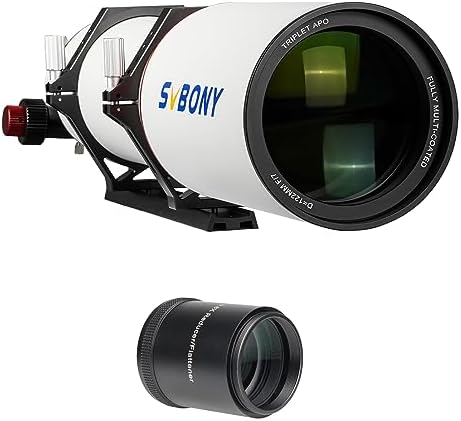
This bundle includes an SV209 0.8X focal reducer field flattener designed for prime focus astrophotography. It corrects field curvature improving imaging quality at the edges.
We may earn a commission when you buy through this link, at no additional cost to you.
The 122mm aperture gathers more light offering clear detailed images suitable for deep sky photography. Its FPL-51 triplet apochromatic lens structure reduces chromatic aberration.
Imaging efficiency is improved significantly compared to standard refractors. The kit is designed for shooting astronomy enthusiasts.
This is a top choice for advanced astrophotographers. It provides everything needed for wide-field imaging.
The 0.8X focal reducer shortens focal ratio making exposures shorter for deep sky targets.
SV209 flattener corrects defects in the user's shooting target field of view.
We may earn a commission when you buy through this link, at no additional cost to you.
This kit includes the SV209 0.8X focal reducer field flattener designed for prime focus astrophotography. It provides everything needed for a complete imaging setup.
We may earn a commission when you buy through this link, at no additional cost to you.
The SV550 122mm refractor features a compact design with FPL-51 triplet apochromatic lens structure. The OTA weighs manageable amounts for travel.
A portable handle and dovetail base allow easy carrying of the large-aperture telescope. It fits into the carrying case conveniently.
Recommended for photographers wanting a ready-made solution. It removes guesswork from accessories selection.
Compact refractor design with carrying handle makes transport easy for observers on the move.
SV209 flattener included for correcting field curvature and improving edge quality.
We may earn a commission when you buy through this link, at no additional cost to you.
This kit uses a triplet apochromatic optics structure with S-FPL51 low-dispersion ED glass. It effectively improves the blue-edge chromatic aberration problem of single-ED imaging.
We may earn a commission when you buy through this link, at no additional cost to you.
The SV209 field flattener is special for the SV550 80F6 OTA to improve image quality. Sharp images are achieved with ultra wide band fully multilayer coated lens.
Double glass and 30mm achromatic optics prevent irritating reflections. Users experience bright and clear images for observing celestial bodies.
Ideal for beginners seeking a complete optical system. It offers solid performance for deep sky targets.
Ultra wide band fully multilayer coated lens prevents reflections for brighter views.
Comfortable and convenient carrying handle improves safety factor during installation.
We may earn a commission when you buy through this link, at no additional cost to you.
This bundle includes a mini guide scope and a telescope camera. It is designed for autoguiding or planetary imaging. The telescope weighs manageable amounts for travel.
We may earn a commission when you buy through this link, at no additional cost to you.
The telescope camera is compact with a high sensitive 1.23-megapixel color camera sensor. Its small pixels allow tight tracking of faint guide stars.
It is compatible with mainstream auto guiding cameras using 1.25in and M42 mount interfaces. This makes integration into existing systems easy.
Perfect for photographers wanting a turnkey imaging solution. It covers everything needed for guiding and imaging.
1.23-megapixel color camera with high peak QE allows tight tracking of faint stars.
M42 mount interface ensures compatibility with mainstream auto guiding cameras.
We may earn a commission when you buy through this link, at no additional cost to you.
Selecting the right refractor involves balancing optical quality with portability. Below are essential factors to consider.
Aperture determines light-gathering power. Larger apertures like 122mm allow you to see fainter deep sky objects than smaller ones.
Prioritize 100mm or more for serious imaging.
Focal ratio affects image scale. Faster ratios like F6 are better for wide-field nebulae while slower ratios suit planetary views.
Choose F6 to F8 for general astrophotography.
Triplet or quadruplet designs using ED glass minimize chromatic aberration better than doublets. Air-spaced designs reduce thermal issues.
Look for triplet ED glass for best color correction.
Weight and size impact transportability. Models with handles and compact tube lengths are easier to set up in the field.
Opt for lightweight magnesium parts if hiking to dark sites.
A smooth dual-speed focuser is vital for precise focusing. Ensure it supports heavy camera loads without flexure.
Look for 1:10 reduction gears for fine adjustments.
Internal light barriers and matte paint reduce stray light. This improves contrast in deep sky imaging.
Check reviews for baffle performance before buying.
Some bundles include field flatteners or guide scopes. These accessories save money but verify compatibility with your camera.
Ensure kits include correct adapters for back focus.
Reliable customer service matters if adjustments are needed. USA-based brands often offer easier access to support.
Choose brands with positive community feedback.
Begin by mounting the refractor securely on a stable equatorial mount. Ensure the dovetail is locked properly to prevent slippage.
Collimate the optics using the push-pull adjustments on the front cell. Check star alignment to ensure tight diffraction patterns.
Clean lenses sparingly with proper solutions. Store in a dry place with dew heaters to avoid condensation during sessions.
An apochromatic refractor uses multiple lens elements including ED glass to minimize chromatic aberration. This results in sharp images with minimal color fringing around stars.
Yes, triplet refractors generally offer superior color correction compared to doublets. They use an extra lens element to correct residual chromatic aberrations.
For astrophotography with larger sensors, a field flattener is often needed to correct field curvature. Visual use typically does not require one.
Weights vary by aperture. Models range from about 5 pounds to 15 pounds. Lightweight magnesium options help with portability.
Stable equatorial mounts with good payload capacity are best. Ensure the mount supports the refractor and camera gear comfortably.
Never use refractors for solar viewing without a full-aperture white light filter. Proper safety equipment is essential to protect eyes.
The top three picks offer excellent balance between optical performance and portability. SVBONY and Askar models lead in value for their respective categories.
Prioritize optical design and mounting compatibility when choosing your system. Your specific observing goals will determine the best aperture size.
Prices and availability change frequently so check current listings before making your final purchase decision today. Happy observing and imaging.