
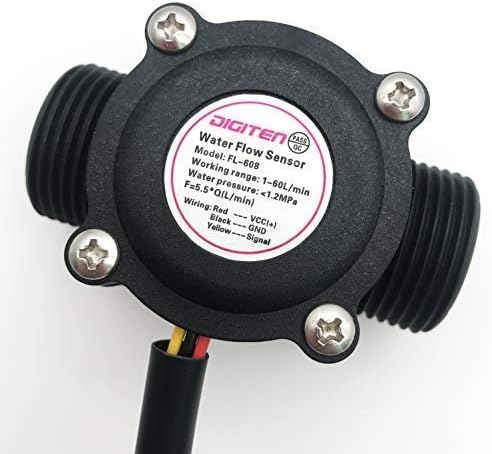
DIGITEN G3/8 Water Flow Sensor
4.5Editor score
Compact G3/8 inch connection
Low voltage 3.5-12V operation
Affordable price point
This guide compares the top ten Arduino flow meter options for precise water measurement in DIY projects and industrial applications.
Selecting the right flow meter for your Arduino project is crucial for accurate data collection and system efficiency. These devices measure water flow rates using hall effect sensors and provide pulse outputs that microcontrollers can easily interpret.
We have evaluated ten popular models based on compatibility, build quality, flow range, and user reviews. Our comparison covers various thread sizes and voltage requirements to help you find the perfect fit for your specific application needs.
Each pick highlights key features and real-world performance insights to guide your decision. Please note that prices and availability may change over time, so check current listings before purchasing your chosen sensor.
4.5Editor score

5.0Editor score

4.9Editor score
The following table provides a side-by-side comparison of all ten selected models. It highlights key specifications like flow range, voltage, and thread size to help you quickly identify the best match for your project.


This DIGITEN model stands out as the top choice for serious makers needing precision and durability. With a perfect five-star rating and a massive flow range, it handles everything from small domestic projects to larger industrial monitoring tasks effortlessly.
We may earn a commission when you buy through this link, at no additional cost to you.
Its all-material compliance with ROHS standards ensures safety for drinking water applications. The square wave output provides clean signals for Arduino interrupt pins. Heat and pressure resistance make it reliable in demanding environments like water heaters.
The main trade-off is the higher cost compared to generic options. Also, using it with NPT pipes requires additional thread seal tape. These minor inconveniences are outweighed by the superior reliability and performance you get.
Buy this if you need a long-lasting sensor for critical systems. It is ideal for automated irrigation, reverse osmosis monitoring, and commercial beverage dispensers where accuracy and safety cannot be compromised.
All materials meet ROHS testing standards making it safe for potable water contact in filters and purifiers.
Designed with heat and cold resistance plus pressure tolerance up to 1.75 Mpa for diverse installations.
We may earn a commission when you buy through this link, at no additional cost to you.
This budget-friendly option delivers solid performance for small-scale projects without breaking the bank. Its compact G3/8 size fits perfectly in tight spaces like under-sink water filters or small coffee machine loops.
We may earn a commission when you buy through this link, at no additional cost to you.
The low voltage requirement of 3.5 to 12 volts makes it compatible with battery-powered setups. The square wave output is consistent enough for basic flow monitoring tasks where extreme precision is not critical.
Users should note it is limited to lower flow rates up to 10 liters per minute. It may struggle in high-volume systems. For light duty applications this limitation is rarely an issue and saves money.
Choose this for prototyping or low-flow home automation. It is a great starting point for beginners learning to interface sensors with Arduino boards on a tight budget.
Small size allows installation in tight spaces like under sinks or inside small appliance housings easily.
Operates on as little as 3.5V making it suitable for battery-powered remote monitoring projects.
We may earn a commission when you buy through this link, at no additional cost to you.
The DEVMO sensor offers premium electrical characteristics that ensure reliable signal processing in noisy environments. Its high amplitude output provides clear distinction between on and off states which reduces false readings in complex circuits.
We may earn a commission when you buy through this link, at no additional cost to you.
With an electrical strength rating of 1250V/min it handles voltage spikes better than standard units. This makes it highly suitable for industrial cooling systems where power fluctuations are common and device protection is vital.
While the price is higher, the reliability justifies the investment for critical setups. It is tailored for specific uses like water cooling and vending machines where stability is more important than raw flow capacity.
Purchase this when signal integrity is your top priority. It is best for advanced projects requiring stable outputs without extra filtering components or complex software debouncing.
High amplitude output ensures clean pulse signals that are easy for microcontrollers to read accurately.
Rated for high electrical strength to withstand voltage variations in industrial or commercial settings.
We may earn a commission when you buy through this link, at no additional cost to you.
This sensor simplifies installation with a direct NPT thread eliminating the need for adapters in many systems. Its lightweight design reduces stress on pipes and makes it easier to mount in tight or overhead spaces.
We may earn a commission when you buy through this link, at no additional cost to you.
The integrated magnetic hall effect sensor outputs a pulse with every revolution ensuring accurate counting. It is sealed from water which protects the electronics and maintains dry safe operation over long periods.
It is important to install it according to the flow direction mark or there will be no signal. This limitation requires careful planning during setup but ensures one-way accuracy in monitoring tasks.
Select this for projects where standard US pipe threads are used. It is a straightforward choice for reverse osmosis systems and beverage machines requiring minimal plumbing complexity.
Includes NPT thread directly on the body for easier connection to standard American plumbing systems.
Hall sensor is sealed from water to stay safe and dry preventing corrosion or short circuit issues.
We may earn a commission when you buy through this link, at no additional cost to you.
This model focuses on basic functionality with food-grade materials suitable for drinking water systems. It is a no-frills option that provides accurate flow counting without unnecessary extras or high costs.
We may earn a commission when you buy through this link, at no additional cost to you.
The wide working voltage range from 5 to 24 volts offers flexibility in power sources. This allows it to interface easily with various logic levels found in different microcontroller platforms and relay boards.
While the user rating is slightly lower it still functions well for standard applications. The trade-off is a simpler construction that may lack the ruggedness of higher-end models in extreme conditions.
Buy this for simple home water monitoring projects. It is a practical choice for coffee makers or purifiers where cost efficiency and material safety are the main concerns.
Constructed from food grade plastic ensuring safety for potable water use in kitchen applications.
Supports a wide voltage range making it compatible with many different power supplies and logic systems.
We may earn a commission when you buy through this link, at no additional cost to you.
This unique sensor features a transparent valve body allowing you to visually observe water flow and rotor conditions. It comes in a two-pack which is convenient for testing or deploying multiple units in different locations.
We may earn a commission when you buy through this link, at no additional cost to you.
The impeller uses stainless steel beads for wear resistance ensuring longevity even with hard water. The rotor assembly is isolated from the water line to protect the internal hall sensor from moisture damage.
The lower rating suggests users may have had issues with breakage due to the plastic construction. The body is flexible which can be an advantage for fitting but also a risk for durability over time.
Choose this if visual verification of flow is important for your project. The two-pack offer makes it cost-effective for experiments where you might need spares or redundancy.
Transparent body allows you to see water flow and rotor movement directly without removing the sensor.
Stainless steel beads in the rotor assembly provide better wear resistance than plain plastic components.
We may earn a commission when you buy through this link, at no additional cost to you.
This small sensor connects directly to standard hosepipes making it perfect for low flow applications like misting or small cooling lines. It is designed for systems where water volume is minimal and precision is needed.
We may earn a commission when you buy through this link, at no additional cost to you.
With a flow range of 0.3 to 6 liters per minute it is not suitable for standard household plumbing. The lower pressure limit of 0.8 Mpa means it should be used in protected low-pressure circuits.
The food grade material ensures safety for contact with drinking water in small dispensers. The small size helps save space in tight enclosures where larger sensors would not fit.
Select this for aquariums or mini irrigation systems. It works best where hosepipe connections are standard and high flow rates are not required.
G1/4 connector is ideal for standard hosepipe connections without needing extra adapters or fittings.
Accurate for very low flow rates allowing detailed monitoring of small water volumes in delicate systems.
We may earn a commission when you buy through this link, at no additional cost to you.
This Taidacent unit is engineered specifically for water heater inlet detection providing precise influent flow rate monitoring. It features a perfect five-star rating indicating consistent satisfaction among users who demand reliability.
We may earn a commission when you buy through this link, at no additional cost to you.
The magnetic rotor assembly changes speed with flow rate allowing the hall sensor to output a corresponding pulse signal. The controller receives this feedback to regulate systems automatically based on real-time water movement data.
The interface style is specific with 4 points at G1/2 which may limit direct compatibility without adaptors. However this precision design ensures a tight seal and accurate measurement within its intended application areas.
Purchase this for water heater automation projects. It is an excellent choice when you need a dedicated sensor that understands the dynamics of heater inlet flow patterns.
Designed to detect influent flow rates specifically for water heater control systems and regulation.
Rotates with flow rate changes to feed precise pulse signals back to the main controller.
We may earn a commission when you buy through this link, at no additional cost to you.
This model solves wiring headaches by including a 1.2 meter cable pre-attached to the sensor body. It maintains the reliable performance expected from DIGITEN while adding convenience for remote installations.
We may earn a commission when you buy through this link, at no additional cost to you.
The waterproof design ensures it can be installed in wet environments without extra housing. The square wave output provides clean signals that are easy to read by Arduino interrupt pins directly.
You must use thread seal tape if adapting to NPT pipes. The fixed cable length is usually enough but may not suit very deep enclosures where longer wiring is needed for connection.
Choose this for projects where the Arduino board is located away from the plumbing. The included cable saves time on custom wiring and reduces potential connection errors.
Includes a 1.2 meter cable to simplify wiring for sensors installed away from the main controller.
Waterproof and heat resistant design allows safe use in wet or variable temperature environments.
We may earn a commission when you buy through this link, at no additional cost to you.
This sensor supports larger pipe systems with a G3/4 connection and a flow range up to 60 liters per minute. It includes a cable for convenient connection to controllers placed further from the main pipe.
We may earn a commission when you buy through this link, at no additional cost to you.
Despite the high capacity the rating is the lowest in this list suggesting potential reliability issues or user dissatisfaction. It withstands pressure up to 1.75 Mpa but requires careful handling during installation.
The square wave output is standard but might need filtering in high flow scenarios. The cable length is fixed which limits flexibility if your setup requires different wiring distances or routing.
Use this only for specific larger flow requirements. It is a trade-off between capacity and reliability but the cable convenience helps offset some installation time.
Supports up to 60 liters per minute making it suitable for larger commercial or industrial water systems.
G3/4 inch connection fits larger standard pipes where smaller sensors would be insufficient for volume.
We may earn a commission when you buy through this link, at no additional cost to you.
Choosing the right sensor involves matching technical specs to your specific needs. Understanding these factors will help you avoid compatibility issues and ensure accurate measurements.
The flow range indicates the minimum and maximum water volume the sensor can measure accurately. Selecting a model that matches your expected usage is essential. If your project needs high flow like irrigation a wider range is necessary.
Choose a flow range that covers your expected usage.
Thread type determines how the sensor connects to your plumbing system. Common options include BSPT and NPT. Using the wrong thread requires adapters which adds cost and risk of leaks.
Match the thread type to your existing pipes.
Working voltage is the electrical power required for the sensor to operate. Most units work between 5V and 18V. Ensure your power supply and logic levels match this to avoid damage.
Verify voltage matches your Arduino power source.
Pressure resistance shows how much water pressure the sensor can withstand without breaking. Typical ratings are around 1.75 Mpa. Higher pressure systems require robust sensors to prevent bursting.
Check pressure limits for your system.
Food safety ensures the materials used are safe for contact with drinking water. Look for ROHS compliance. This is critical if you are building projects for drinking water or food dispensing.
Ensure food-grade certification for safe water.
Signal output describes how the sensor communicates flow data to your microcontroller. Hall effect sensors typically output square waves. A clear signal simplifies code and improves reading accuracy.
Confirm signal output type matches your code.
Cable length is the distance of wiring from sensor to connector. Longer cables allow remote placement. If the cable is too short you may need extension wires which adds complexity.
Measure your wiring needs for correct cable length.
Durability refers to how well the sensor withstands environmental factors like heat and water. Robust materials ensure long life. This matters most for systems running continuously or in harsh conditions.
Prioritize durability for continuous operation.
Install the sensor in a straight pipe run with enough space before and after to ensure laminar flow. Ensure the flow direction arrow on the body points the same way as the water moving through the pipe.
Connect the signal wire to a digital interrupt pin on your Arduino. Use the internal pull-up resistor in your code to keep the line stable when not pulsing and read counts accurately.
Clean the sensor regularly by removing the rotor and wiping away debris. Check the seals for wear and replace if you notice any leaks. Avoid exposing the body to direct heat sources.
The DIGITEN G1.5 is often considered best overall due to its wide flow range and perfect five-star rating. It offers excellent durability and safety for potable water. Other top options include the DEVMO for premium signal quality.
Most are designed specifically for liquid measurement. Using them for air can damage the rotor or give false readings. Always verify the product manual specifies gas use before attempting it with your project.
Yes most Arduino boards have internal pull-up resistors. Enable these in your code to stabilize the signal line. This prevents noise interference and ensures accurate pulse counting during operation.
Multiply the pulse count by a calibration factor. Each sensor has a unique pulse per liter value. Divide total pulses by time in minutes to get the flow rate in liters.
NPT stands for National Pipe Tapered which is a standard US thread type. If your plumbing uses BSPT you will need an adapter. Check your pipe threads before buying to ensure a direct fit.
Yes the hall effect sensor inside is sealed from the water. The plastic body is waterproof but the electrical connector should be kept dry. Avoid submerging the entire unit beyond its rated pressure limits.
We reviewed ten distinct flow sensors suitable for Arduino projects. The DIGITEN G1.5 offers the best balance of range and quality. The DEVMO model leads in electrical precision for industrial use.
Prioritize flow range and thread type to ensure compatibility. A sensor that matches your physical setup saves installation time. Check voltage ratings to prevent hardware damage.
Prices and availability change frequently so verify current listings before buying. This guide provides a solid foundation for selecting the right tool for your specific water measurement needs.