
Lenovo ThinkPad P16s Gen 4
4.0Editor score
Intel Ultra 7 255H
32GB DDR5 RAM
MIL-STD-810H Tested
Portable Workstation Design
Electrical engineering demands powerful tools capable of handling complex simulations, CAD design, and data analysis. Choosing the right laptop ensures you can work efficiently on campus or in the field without sacrificing performance or reliability during critical projects.
We evaluated leading workstations based on processor speed, graphics capabilities, and build quality. Our comparison focuses on ISV certified models that run industry software like MATLAB, AutoCAD, and ANSYS smoothly. Each entry balances raw power with portability for students and professionals.
Every pick highlights specific strengths such as battery life, display quality, and connectivity options. Ratings reflect user feedback and technical specs to help you decide confidently. Remember that availability and pricing fluctuate, so verify current details before making your final purchase decision today.
4.0Editor score

4.4Editor score

5.0Editor score
As an Amazon Associate we earn from qualifying purchases.
This side-by-side comparison lists all ten selected workstations and devices. We highlight key specifications including processors, memory, and connectivity to help you identify the model that best fits your specific engineering workflow and budget requirements.




The Dell Precision 7680 stands as a top-tier workstation designed for rigorous engineering tasks. With a 4.4 star rating, users appreciate its robust performance capabilities for CAD and simulation workloads.
We may earn a commission when you buy through this link, at no additional cost to you.
This laptop features the Intel Core i9-13950HX processor which delivers exceptional multi-core performance. The 32GB of DDR5 RAM ensures seamless multitasking when running complex engineering software alongside browser tabs and documentation tools.
While it is built for power, the weight and cost may be considerations for students. However, the stability and reliability offered by the ISV certifications make it a worthy investment for professional environments.
We recommend this machine for engineers who need desktop-class performance in a portable form factor. Its ability to handle demanding workflows makes it an excellent choice for both academic and industrial projects.
The Intel Core i9-13950HX processor provides the raw speed needed for complex simulations and data analysis tasks.
Support for up to three external monitors allows for expanded workspace and improved productivity during design reviews.
We may earn a commission when you buy through this link, at no additional cost to you.
This configuration of the Dell Precision 7680 offers a balanced approach for engineering students and professionals. The inclusion of the NVIDIA RTX 1000 Ada GPU provides necessary graphical horsepower for rendering and CAD applications.
We may earn a commission when you buy through this link, at no additional cost to you.
Powered by the Intel Core i5-13600HX processor, it handles most engineering workloads efficiently. The 32GB of DDR5 CAMM RAM offers high bandwidth and efficient thermal management for sustained performance sessions.
Users may find the CPU is less powerful than the i9 variant, but for general design work, it remains capable. The durability testing ensures it can withstand the rigors of daily transport between labs and offices.
This model is ideal for those who need specific GPU acceleration without paying for the highest-end CPU. It strikes a good balance between performance and cost for demanding technical workflows.
The NVIDIA RTX 1000 Ada GPU ensures smooth visualization of 3D models and complex electrical diagrams.
MIL-STD-810H testing confirms the chassis can resist shocks and environmental stresses during travel.
We may earn a commission when you buy through this link, at no additional cost to you.
The Lenovo ThinkPad P16s Gen 4 combines mobility with workstation capability, making it a strong contender for students. It offers a large 16-inch display while maintaining a more portable design than heavy desktop replacements.
We may earn a commission when you buy through this link, at no additional cost to you.
Powered by the Intel Core Ultra 7 255H processor, it delivers solid performance for coding and design tasks. The 32GB of DDR5 RAM ensures you can keep multiple applications open without slowing down your workflow.
One trade-off is the integrated graphics which may limit high-end rendering capabilities. However, for electrical engineering tasks focused on logic and schematic design, this limitation is often negligible.
We suggest this laptop for students who need a reliable daily driver that can handle coursework and light simulations. The connectivity options and durability make it a practical choice for long-term use.
Support for Wi-Fi 7 ensures future-proof wireless speeds for cloud collaboration and large file transfers.
The backlit keyboard and classic ThinkPad design provide comfortable typing for long coding sessions.
We may earn a commission when you buy through this link, at no additional cost to you.
This high-end configuration of the Dell Precision 7680 is perfect for data-intensive engineering projects. With a perfect 5.0 star rating, users are highly satisfied with its ability to handle complex simulations and large datasets.
We may earn a commission when you buy through this link, at no additional cost to you.
The 64GB of DDR5 RAM is the standout feature, allowing for massive virtual machines and complex finite element analysis without slowdowns. The RTX 2000 Ada GPU ensures smooth rendering of detailed 3D models and circuits.
While the cost is significant, the productivity gains from having such powerful hardware are clear for professional engineers. The 2TB SSD provides ample space for extensive project files and software libraries.
We recommend this model for senior engineers or researchers who need the maximum performance available. It transforms complex processing tasks into routine operations with speed and reliability.
64GB of RAM allows simultaneous operation of multiple heavy engineering applications without system lag.
The 2TB PCIe NVMe SSD ensures quick load times for large simulation files and operating system.
We may earn a commission when you buy through this link, at no additional cost to you.
This model focuses on delivering robust graphics performance for visualization and simulation tasks. The NVIDIA RTX 2000 Ada GPU is a significant upgrade for graphical workloads compared to integrated solutions.
We may earn a commission when you buy through this link, at no additional cost to you.
Powered by the Intel Core i7-13850HX processor, it balances processing power with graphics capability. The 2TB SSD provides plenty of room for storing extensive software suites and project archives.
Users may note the 32GB RAM is standard but might not suffice for extremely memory-heavy tasks compared to the 64GB version. The rating reflects varied experiences with specific workflow demands.
It is a solid choice for engineers whose work relies heavily on visual rendering and GPU acceleration. The balance of specs makes it versatile for both coding and graphics-intensive design work.
The RTX 2000 Ada enables efficient rendering of complex electrical schematics and 3D mechanical parts.
With a 2TB drive, users have ample space for local backups and large project datasets.
We may earn a commission when you buy through this link, at no additional cost to you.
The HP ZBook Firefly 14 G11 redefines what a mobile workstation can be for traveling engineers. Weighing only 3.13 lbs, it offers professional performance in a form factor that fits easily into a backpack.
We may earn a commission when you buy through this link, at no additional cost to you.
Powered by the Intel Core Ultra 7 165U processor, it prioritizes efficiency and battery life without compromising speed. The 32GB of DDR5 RAM handles everyday engineering tasks and multitasking with ease.
While the 14-inch screen might feel small for complex CAD layouts, the portability often outweighs this trade-off for field work. The 5MP IR webcam ensures secure and clear video conferencing with colleagues.
We recommend this laptop for engineers who frequently commute or work on-site. Its combination of certified performance and light weight makes it ideal for productive work anywhere.
At 3.13 lbs, this laptop is easy to carry to client sites or lecture halls without strain.
Built-in fingerprint reader and IR webcam enhance security for sensitive engineering data and access control.
We may earn a commission when you buy through this link, at no additional cost to you.
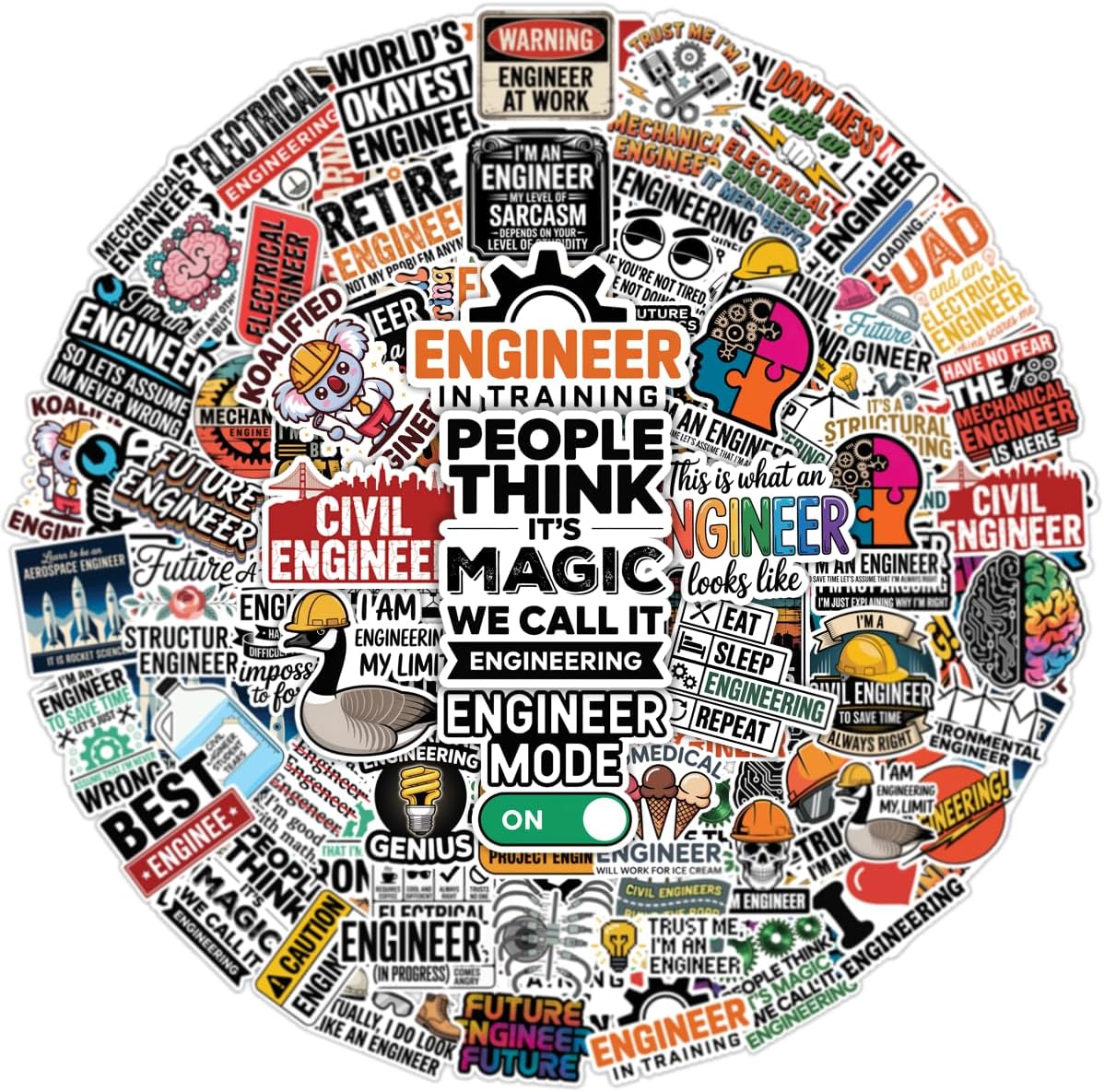
While not a computer, these 64-piece stickers provide a creative way to personalize engineering gear and notebooks. They feature various STEM themes including electrical, mechanical, and industrial designs.
We may earn a commission when you buy through this link, at no additional cost to you.
The high-quality waterproof vinyl ensures they stay vibrant even on water bottles or outdoor equipment. This makes them a durable accessory for students and professionals alike.
There are no functional specs to compare as this is a decorative item. However, it adds a touch of personality to your workspace or study materials effectively.
We suggest this as a fun gift for engineering students or colleagues. It complements your main equipment by adding style to the tools you use daily.
UV-resistant and scratch-proof vinyl ensures the stickers maintain their look over long periods of use.
With 64 pieces, there is a design for every niche from robotics to structural engineering and more.
We may earn a commission when you buy through this link, at no additional cost to you.
The Dell Precision 7780 offers a massive 17.3-inch display for engineers who prefer more visual space. This model is built for performance and comfort rather than frequent portability.
We may earn a commission when you buy through this link, at no additional cost to you.
Powered by the Intel Core i9-13950HX processor, it delivers top-tier speed for processing complex algorithms and simulations. The RTX 2000 Ada GPU ensures smooth visualization of detailed project plans.
Due to its size and weight, this laptop is best suited for desk use or transport by car. Users appreciate the screen size for multitasking with multiple open windows simultaneously.
We recommend this for users who have a dedicated workspace and prioritize screen real estate over mobility. It offers a desktop-like experience for heavy engineering workloads.
The 17.3-inch screen allows detailed viewing of full schematic diagrams without constant zooming.
High-end specs ensure that rendering large circuit layouts happens quickly without lag.
We may earn a commission when you buy through this link, at no additional cost to you.
These stickers bring humor to engineering gear with funny quotes about volts, amps, and ohms. They are a perfect way to add personality to tools and safety equipment.
We may earn a commission when you buy through this link, at no additional cost to you.
Made from high-quality waterproof vinyl, they are designed to withstand tough conditions on job sites. This durability ensures the graphics remain intact even in harsh environments.
There are no technical specs beyond the material quality and application surface. However, their utility as a personalization tool is high for those in the electrical trade.
We suggest this as a lighthearted gift for students or professionals. It serves as a fun reminder of the basics in a playful and engaging way.
Weatherproof design ensures the stickers last even when exposed to rain or rough handling.
Easy to peel and apply on smooth surfaces like laptops or toolboxes without residue.
We may earn a commission when you buy through this link, at no additional cost to you.
The HP OmniBook 3 offers a budget-friendly entry point for basic computing needs. With a large 17.3-inch display, it is suitable for browsing and light document editing.
We may earn a commission when you buy through this link, at no additional cost to you.
Powered by the AMD Ryzen 3 processor and 8GB of RAM, it manages everyday tasks well. The battery life supports long sessions away from a power outlet for students.
For complex engineering work, this laptop may struggle due to limited memory and graphics power. It is best used for research and writing rather than heavy simulations.
We recommend this for students on a tight budget who need a large screen for reading and research. It provides essential computing functions without a high financial barrier.
Up to 14 hours of battery life ensures productivity throughout the day without constant charging.
Wi-Fi 6 support provides stable connections for streaming and online classes in crowded areas.
We may earn a commission when you buy through this link, at no additional cost to you.
Selecting the right laptop for electrical engineering involves balancing performance, portability, and budget. Understanding key hardware requirements helps you avoid bottlenecks during complex design and analysis tasks.
The processor is the brain of your laptop and is critical for running simulation software. Look for multi-core processors from Intel Core i7 or i9 series to handle complex computations efficiently.
Prioritize high clock speeds and multiple cores to ensure smooth performance during intensive processing.
While electrical engineering does not always require gaming-grade graphics, many CAD tools benefit from dedicated GPUs. NVIDIA RTX series cards provide certified performance for professional visualization tasks.
Choose a model with a dedicated GPU if you plan to render 3D models frequently.
RAM is essential for multitasking and running memory-heavy applications simultaneously. A minimum of 16GB is recommended, but 32GB offers future-proofing for larger datasets and virtual machines.
Ensure the laptop supports at least 32GB of RAM for optimal long-term performance.
Fast storage reduces load times for large software suites and project files. NVMe SSDs are standard in modern laptops and provide the speed needed for responsive workflows.
Look for a storage capacity of at least 512GB to accommodate software and project data.
A high-resolution display helps in viewing intricate schematics and multi-window layouts comfortably. Aim for Full HD or higher resolution with anti-glare coatings to reduce eye strain.
Prioritize larger screens or dual monitor support if you work with detailed diagrams often.
ISV certification ensures that the laptop has been tested with professional engineering software for stability. This certification is vital for avoiding crashes during critical work on projects.
Check for ISV certifications from major software vendors before making your final decision.
If you move between labs or classrooms frequently, weight and battery life become important factors. Lighter workstations under 4 lbs offer better mobility without sacrificing too much power.
Select a build that balances durability with weight to suit your daily carry needs.
Modern engineering often requires connecting to external monitors, development boards, and sensors. Ensure the laptop has enough USB ports, Thunderbolt support, and HDMI outputs.
Verify that the port selection matches the peripherals you need for your specific work.
Always ensure your software is updated to the latest versions to maintain compatibility with engineering tools. Regular driver updates from manufacturers help optimize performance and security.
Use a cooling pad if you run heavy simulations for extended periods to prevent overheating. Proper ventilation extends the life of the internal components.
Back up your project data regularly to external drives or cloud storage to prevent data loss. This practice ensures you do not lose critical work due to hardware failure.
The minimum RAM needed for electrical engineering is typically 16GB. However, 32GB is recommended for handling large simulations and multitasking efficiently without slowdowns.
A dedicated GPU is beneficial for CAD and 3D modeling tasks. Integrated graphics may suffice for basic coding but dedicated cards offer better stability for complex software.
Workstations are often better due to ISV certifications and enterprise-grade build quality. Gaming laptops offer good performance but may lack stability for professional software.
Battery life is crucial for students and field engineers who move frequently. Aim for a laptop that offers at least 8 hours of battery life for productivity on the go.
MacBooks are good for coding but lack support for some Windows-specific engineering software. Check your software requirements before choosing a Mac for engineering tasks.
A screen size of 15 to 17 inches is ideal for viewing detailed schematics. Larger screens allow for better multitasking without external monitors.
We have reviewed ten top options ranging from powerful workstations to portable solutions. The Dell Precision series offers robust performance while the HP ZBook provides excellent mobility.
Prioritize performance based on your specific needs such as simulation power or portability. Understanding your workflow ensures you choose a laptop that supports your career effectively.
Prices and availability change frequently so always verify current details before purchasing. Check for student discounts and educational pricing to maximize your investment.